Cette publication est également disponible en :
 Français
As Halloween approaches, we are all thinking about the terrifying creatures that haunt our screens, our nightmares or our real lives… What if fear also reached us through our noses? This is, at any rate, a subject that a number of authors have seized upon, giving the sense of smell a central – and frightening – role in their dystopias.
We invite you on a literary overview in which perfume is no longer a luxury, but the last testament to our humanity and, at times, the first sign of our downfall.
An article by Clément Paradis, from the main feature of the 21st issue of Nez, “The Smell of the Future.”
Our readers know this: At Nez, we refuse to call perfumers “noses,” because they are also – and above all – minds that think, hands that write and measure, and so on. But what does the future hold? In 1944, in Future Times Three, writer René Barjavel describes a time traveler’s discovery of humanity in the year 100,000. By then, the species had produced highly specialized types, notably “watchers”: On frail bodies, some had developed stalked eyes, others ears as wide as banana leaves, and still others were almost entirely reduced to elephant-trunk noses. Perhaps the distant descendants of famous perfumers!
Barjavel is not the only science fiction author to have explored olfactory themes. Today, literary scholars like Chanelle Dupuis and art historians like Clara Muller are combing through our culture to uncover little-known bodies of work that invite us, through olfactory adventures, to better observe and understand the present.
Images of a techno-olfactory future
By the end of the 19th century, the West was gripped by a frenzy of capturing and recording. In the space of a few years, the world was turned upside down: Bell transmitted the human voice over a wire and filed a patent for the telephone in 1876; Edison captured sound on wax cylinders and invented the phonograph the following year; and in 1874, in the laboratory of German chemists Ferdinand Tiemann and Wilhelm Haarmann, vanillin was synthesized for the first time, promising to replicate the precious scent of the pod at a lower cost. A sense of incompleteness nevertheless prevailed: If sound and image could travel and be preserved, why should scent – the sense of time and intimacy – remain the final frontier of the ephemeral? In 1878, Clara Muller notes in her article “Design for the nose: A brief history of olfactory objects,” this question crystallizes in the pages of Le Figaro, in a column by a certain Louis de Beaumont – a science popularizer with a vivid imagination – who enthuses about a remarkable invention by Edison that had reportedly been presented to him: the Microdor. “With this instrument, man will be able to concentrate the emanations of bodies, amplify them and make them perceptible at enormous distances,” the article explains. Ideas for applications abound: “While hunting, you will be your own pointing dog, and no scent of fur or feather will escape the delicate senses of your instrument,” and “you will easily find, even if it has passed through a thousand different hands, the lost wallet or piece of jewelry; you will be able to recognize, right on the boulevard, the dandy who flirted with your wife one evening.”
Thus spreads the dream of an “augmented” sense of smell, in which a machine would compensate for the biological atrophy of modern man, who is said to have lost his animal instinct upon entering civilization. Of course, there is no trace of such a project in Edison’s work. In 1878, then, literature continued to seize upon what science could not solve, and another journalist, the Swede Claës Lundin, published a text that was this time openly science fiction: Oxygen och Aromasia.
The work is not a standalone piece, as it draws inspiration from a short story by the father of German science fiction, Kurd Lasswitz, “Bis zum Nullpunkt des Seins” (“To the Zero Point of Existence”), which the Swedish author likely discovered in the collection Bilder aus der Zukunft (“Images of the Future”), published that same year. Claës Lundin’s novel expands on the framework established by the author from Breslau: In the year 2378, music as we know it has almost disappeared, because human hearing has become dulled by the incessant noise of past centuries. The dominant sense has become smell. The heroine, Aromasia, is a virtuoso on an instrument called the “ododion,” a scent piano that, instead of producing sounds, releases combinations of essences into the concert hall. Her concerts are described as symphonies where scents follow one another, intertwine and create complex emotions in the audience, just as a melody would.
The starting gun has been fired: For a minority of authors, the future will be techno-olfactory or it will not be at all. The American Clement Fezandié, author of the short story “The Super-Nose,” (1922) part of the series Dr. Hackensaw’s Secrets, revisits the theme of the scent machine, combining a “smell-o-meter” that quantifies smells, an “olfactograph” that measures them for later use, and a “microdorscope,” a scent amplifier. Clement Fezandié reviews the many uses he envisions for such an invention, ranging from perfecting cuisine to detecting diseases. He also imagines fragrance libraries where every memory and every place is recorded on mechanical storage devices.
This idea also runs through the short story “Dans la cité future” (“In the Future City”), written in 1923 by Bernard Gervaise. In a futuristic city entirely covered by a glass roof, “olfactory discs” are part of the new forms of entertainment, used to play symphonies of scents on a sort of olfactory gramophone. Scent becomes a form of data, a trail that can be classified, catalogued and replayed endlessly, including in a new art form that, according to Clement Fezandié, would allow for the performance of “garlic symphonies” capable of moving “any Italian soul.”
In the wake of the police
Mainstream literature soon began to explore these themes. In 1932, Aldous Huxley described in Brave New World a future where perfume is woven into everyday life [see the article “Brave New World: Smelling the future” in Nez #15]. The characters use perfumes dispensed by taps in bathrooms, notably chypre, a favorite of the heroine, Lenina. Fragrances become a source of comfort and pleasure, but also a symbol of conditioning, embodied in particular by “scented cinema,” enjoyed by a crowd living standardized lives. The motif of the scent organ resurfaces as a symbolic element of mass entertainment and political domination through bodily pleasure. In the newly opened cabaret at Westminster Abbey, it is the flagship instrument that stimulates the senses, subjecting the audience to refrains played on a loop accompanied by fragrant wafts, notably ambergris and sandalwood. A lack of meaning nevertheless dominates the works being shown, which turn out to have been created by “Emotion Engineers.” One of the characters sums it up: “We must choose between happiness and what used to be called high art. We have sacrificed high art. Instead, we have scented films and the perfume organ.” Insidiously, scent serves here as a tool for state stability. By saturating entertainment venues with soothing synthetic fragrances, the global state bypasses rational thought through sensory stimulation: Repression is not achieved through force, but through the pursuit of pleasure. Huxley thus penned one of the first texts to theorize sensory marketing and social control through scent, taken to the extreme of dystopia.
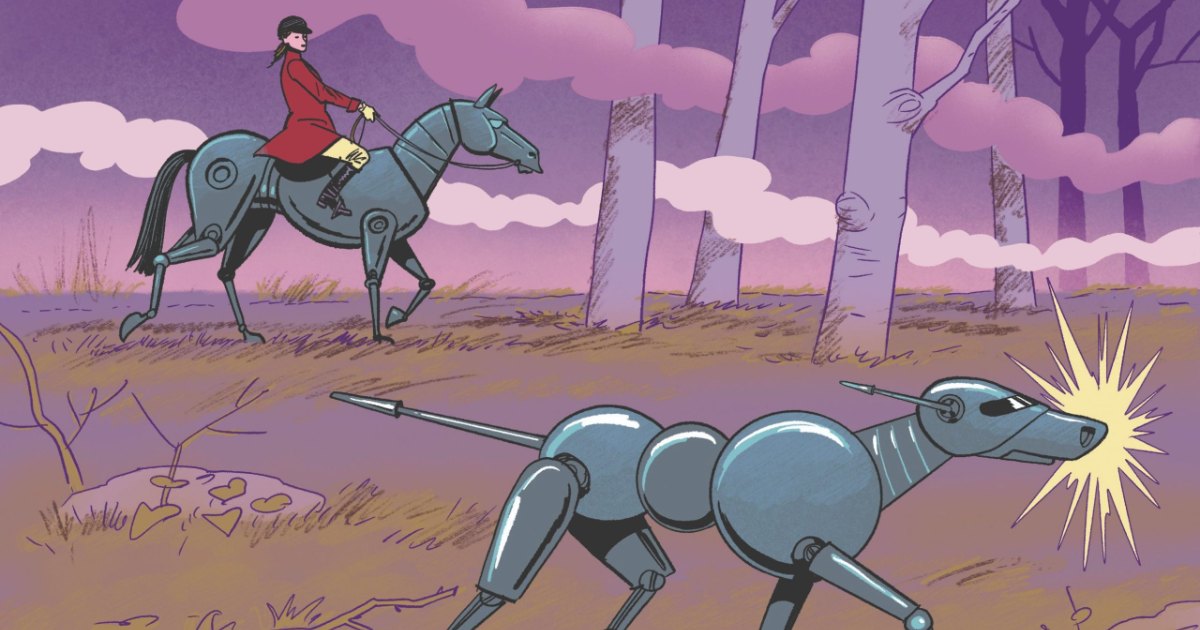
The theme of control, however, had been brewing among Huxley’s predecessors: The “nose-machine” enthusiasts Beaumont and Fezandié also envisioned repressive uses for their inventions. “The official Microdors of the justice system will reconstruct the crime committed in all its phases by analyzing the various scents that accompanied its perpetration,” writes Louis de Beaumont. In Le Figaro, scientific fantasy becomes entangled in law enforcement, just as in the plans of Dr. Hackensaw, who claims to be able to smell the scent of a lie and assists the work of forensic pathologists, while he tests his application in criminology, using it to solve a theft. The most violent embodiment of this anxiety is undoubtedly found in Ray Bradbury’s Fahrenheit 451 (1953), where the sense of smell is a deadly tracking weapon. The Mechanical Hound, with its appendage capable of memorizing 10,000 chemical signatures, embodies a future where identity is no longer a name, but a trail. The robotic creature, half-robot, half-predator, resembling an eight-legged dog-bee, is designed to capture and kill individuals who possess or read banned books. Fleeing is therefore futile: It is their own bodily chemistry that betrays the victims.
Western modernity, marked by rapid urbanization and the hygiene revolutions, recognized early on the need to consider the management of breathable space. From the very opening of Oxygen och Aromasia, the sense of smell has influenced urban planning and housing. The first chapter, titled “The Garden of Aromasia,” features plantings suspended on the rooftops of skyscrapers for their olfactory power. Flowers are selected and cross-bred to create environments saturated with specific scents, transforming the city’s air into a controlled sensory space. For Bernard Gervaise, the metropolis of tomorrow is conceived as an organism whose lungs must be purified; climate is controlled by fans whose air is “infused with fragrant scents captured from afar – in the meadows of Scotland, the fir forests of the Vosges and the rose gardens of Tehran.”
Politics and the control of atmospheres
It is, however, in contemporary literature that air emerges as the site of a political struggle. Chanelle Dupuis’s recent work focuses on two novels in particular: Les aigles puent (Eagles Stink) by Lutz Bassmann (2010) and Frappabord by Mireille Gagné (2024). The first depicts a world devastated by corpses that saturate the air with an eternal stench of tar, making breathing agonizing. The second depicts Quebec suffocating under extreme heat and an epidemic spread by horseflies, where oxygen deprivation and confinement exacerbate social tensions. “These novels present imaginary societies where the scent of nature is altered by human behavior and where access to air and breathing become difficult,” explains Chanelle Dupuis.
The odors of chemical decomposition (in Lutz Bassmann’s work) or of insect-saturated heat (in Mireille Gagné’s work) reflect the violence inflicted upon the very bodies of citizens. Chemical weapons are deployed for specific political reasons: to win the war and annihilate “the enemy.” The extreme stench generated by the bombs becomes the stigma of the victims, the symbol of a blatant abuse of power.
In Frappabord, the control of atmospheres takes on a more environmental and social dimension, mirroring climate change: The virus spread by horseflies is itself the result of a military experiment gone wrong, underscoring that the manipulation of living organisms, and air is an anthropocentric decision with deadly consequences. As Chanelle Dupuis points out, these dystopias show that the climate crisis and military violence create atmospheres that divide social classes: Some have access to clean, air-conditioned air, while others are condemned to suffocation.
Meanwhile, in the anthology Literature and the Senses, contemporary fiction specialist Hsuan L. Hsu develops the concept of “atmospheric violence” – the act of condemning certain populations to live in environments saturated with odors and toxic substances (industrial zones, mines, plantations) – further demonstrating that air is not a neutral domain, but is physically marked by inequalities and discrimination.
Mutations of the self
Science fiction sometimes crosses a disturbing threshold: that of the very mutation of our sensory apparatus. In The New Pleasure, a novel by John Gloag published in 1933, a new drug called Voe, which greatly enhances the sense of smell, is introduced. Its success gradually upends society. Crowded conditions in buildings, public transportation and movie theaters become unbearable, and consumers’ sexual desire intensifies. The novel traces the massive social, political and urban consequences of this transformation over several decades, culminating in an epilogue set 200 years later. Humanity ultimately chooses to put an end to pollution by dismantling its industry to live in a rural utopia: Smelling thus emerges as an act of dissent that sparks a revolution.
One novel goes even further in exploring the profound changes linked to the sense of smell: Spider Robinson’s Telempath, published in 1976. In it, the author imagines a humanity struck by a “hyperosmic plague,” which develops a sense of smell so powerful that it soon transforms into “telempathy” – a direct communication of emotions and thoughts facilitated by the perception of previously indiscernible gaseous entities. In this world, personal privacy collapses: The fear, desire or lies of others is clearly perceptible through pheromonal emissions. Radical transparency redefines the social contract. How can we live together when our most secret emotions float in the air, accessible to the first passerby? Smell thus becomes a permanent exposure that leaves no choice but brutal honesty, isolation or the learning of a new form of empathetic communion to avoid sinking into madness.
The shift from speech to biochemical signals is explored even more radically in posthuman science fiction. Dietmar Dath’s novel The Abolition of Species (2008) features the Gente, post-animal beings whose communication relies on “pherinfones.” Technology no longer takes the form of an external prosthesis; here, it is an integrated biological function: The exchange of complex information – ranging from the transmission of historical data to political management – occurs through the synthesis and emission of odorous and chemical molecules. The Gente “sniff” their environment to read history, politics and emotions within it, turning the world into a vast text written in scents. This olfactory “ecotecture” shifts the focus away from humans, suggesting that the future of intelligence might lie in a biochemical symbiosis akin to the animal or plant kingdoms. This idea is also found in Octavia E. Butler’s Xenogenesis trilogy (1987–1989), where aliens wield absolute mastery over genetic and chemical manipulation, transforming the act of smelling and tasting into a mode of knowledge and biological fusion with others.
Like a compass
The history of olfactory anticipation implicitly tells the story of our relationship with the world. It highlights a fierce Western desire to control the sensory – a desire that always ends up clashing with the primal or political awareness of the vital necessity of sharing the air. Between the 1878 dream of a microscope capable of unraveling all the mysteries of the atmosphere and the nightmare of air that must be purchased to be remembered – or even of intimacy transformed into a public or commercial archive – the sense of smell stands as a moral and visceral compass. As we close this incomplete literary overview, one question remains, however: Will the future truly be displayed on screens, or will it rather be inhaled, in the silence of an archive or in the urgency of a breath of fresh air?
This article was published in Nez #21 – The Smell of the Future.
Illustration: Erwann Terrier








Comments