Cette publication est également disponible en :
 Français
DSM-Firmenich is marking Paris Design Week by unveiling Anankè in the garden at Maison de Victor Hugo. An excellent opportunity to celebrate the bonds between fragrance, art, and design.
Editorial partnership
Illustrating a work of art with a scent or turning a fragrance into a work of art? DSM-Firmenich has been exploring the space where different disciplines meet for several years, inviting perfumers, designers and artists to create conversations between their languages. The work of some of these creators cannot be seen with the naked eye, while others focus on form, matter, space, or light. Dialogue between them produces creations that do not simply set out to translate an image into an aroma, but to build an experience and convey a message together.
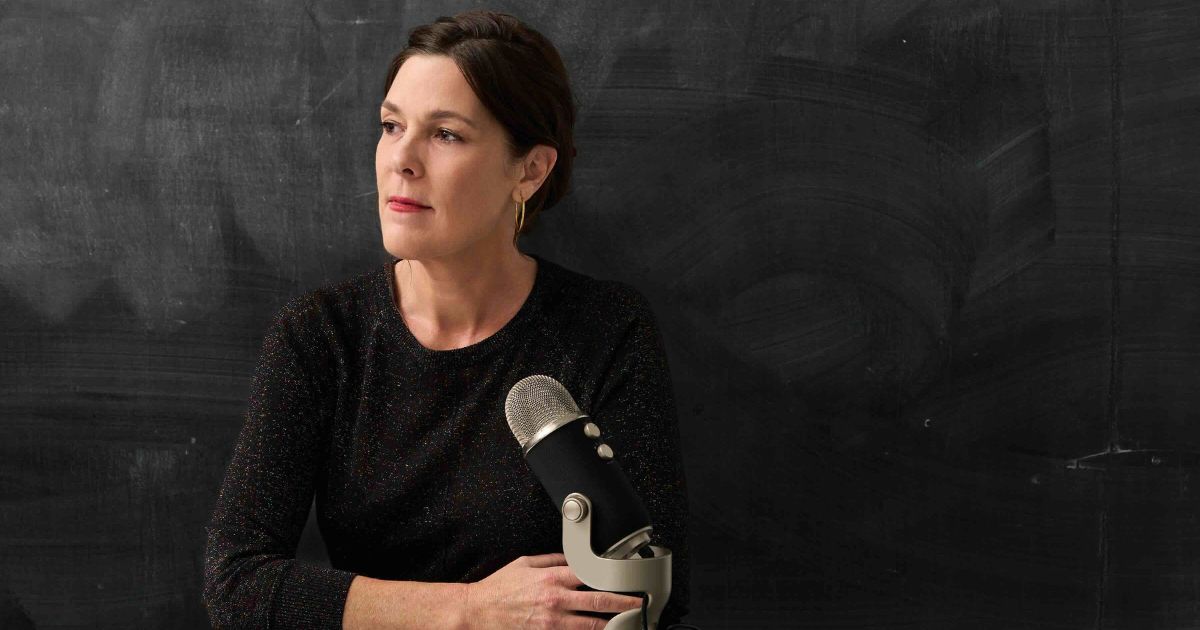
Tucked away in the grounds of the Maison de Victor Hugo on Place des Vosges in Paris is a quiet garden with a café called Papapa, the affectionate nickname given to the poet by his grandchildren. In the garden lies a fragmented menhir emitting aromatic smoke. The stone seems to be breathing clouds of pyrogenic frankincense, juniper and chili. Part of Paris Design Week, the installation is called Anankè and represents the third year of a collaboration involving DSM-Firmenich, in the person of master perfumer Nathalie Lorson this year, designer Lucas Huillet, and fragrance historian Alexandre Helwani. Each year witnesses three perspectives and three disciplines in an encounter delving into major contemporary issues. The first collaboration, Eau Fraîche, installed at the French National Archives site, looked at the consequences of climate change through the prism of one of our most precious resources: water. Flowing through scented fountains, the priceless liquid took on various roles: material, medium, and springboard for a multi-sensory experience of freshness. With Folie at Hôtel de Sully, the trio tackled another topical issue: mental health. A giant chaise longue invited visitors to lie down and take a time-out as scented fabric panels floated above them. The dialogue that sparked the third installation is rooted in the past. Ananke, Greek for inevitability, destiny or necessity, opens the preface to The Hunchback of Notre-Dame. Victor Hugo describes how he discovered the word engraved in a dark corner of one of the cathedral’s towers. The term became the starting point for an exploration of architecture, writing, and transmission.
Anankè, a stone that exhales
“The installation’s focal point is a menhir, the symbol of primitive architecture” explains Lucas Huillet. “When you place a stone, you’re making a mark on the landscape, telling a story. With the print revolution, writing was separated from stone: nowadays photographs and videos have reached another level and have essentially dematerialized our stories.” In response to the gradual disappearance of the material dimension, the Ananké menhir restores an almost archaic sense of presence.
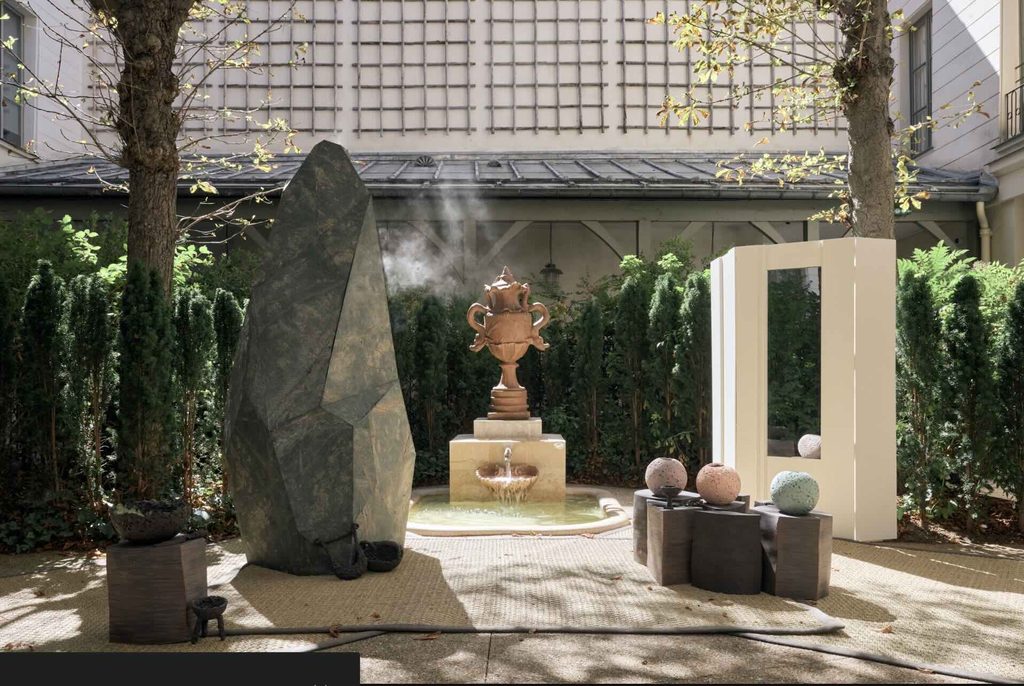
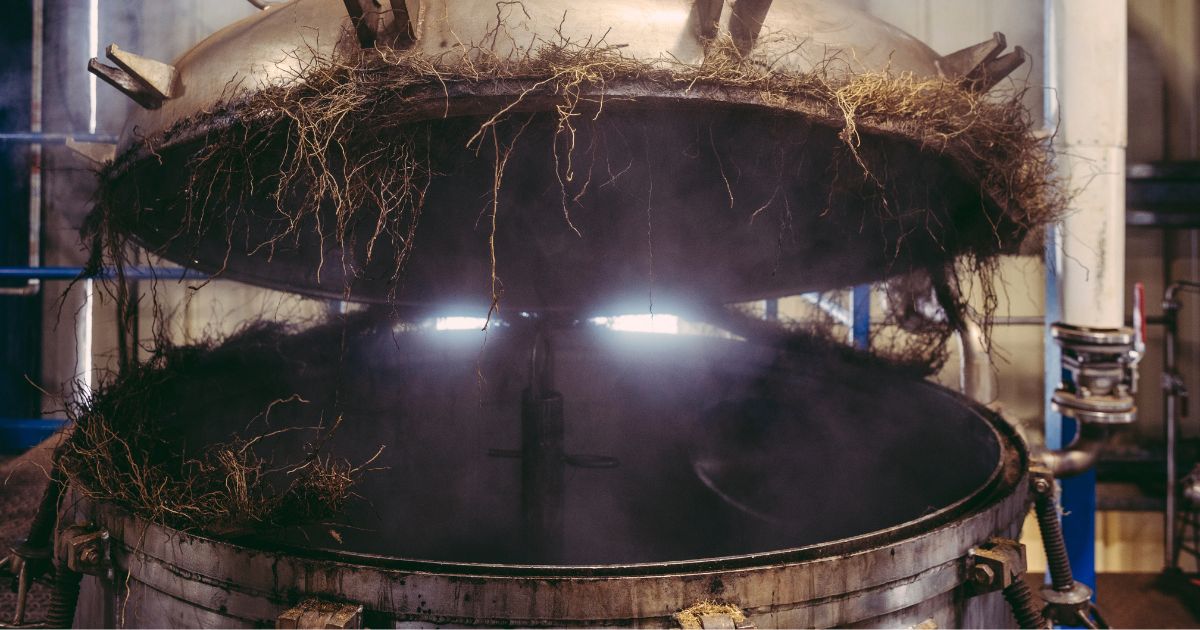
This examination of the earliest forms of architecture is echoed by an evocation of the earliest forms of fragrance: smoke, charred wood, and frankincense. The menhir is transformed into a monumental incense burner. And this is where the dialogue with Nathalie Lorson takes on its full meaning. The master perfumer centered the note on a DSM-Firmenich specialty, pyrogenic frankincense, deepening its intensely smoky feel with hints of juniper. Chili essence adds a rising, metallic, almost incisive vibration. The fragrance does not illustrate the stone, instead, unusually, it becomes visible, escaping from the menhir in smoky swirls, a shifting, ungraspable thing.
Opposite the menhir, three fragmented spheres shift the focus toward a possible future. Each is home to a fragrance and a vision. Éternelle Écume evokes nostalgia for a grandmother’s water-garden at a time when “water could well become rarer and rarer,” says Nathalie Lorson. “In a highly urbanized world, green notes of tomato leaf, cucumber, and algae express the need to get back to nature – a reassuring, familiar nature.”
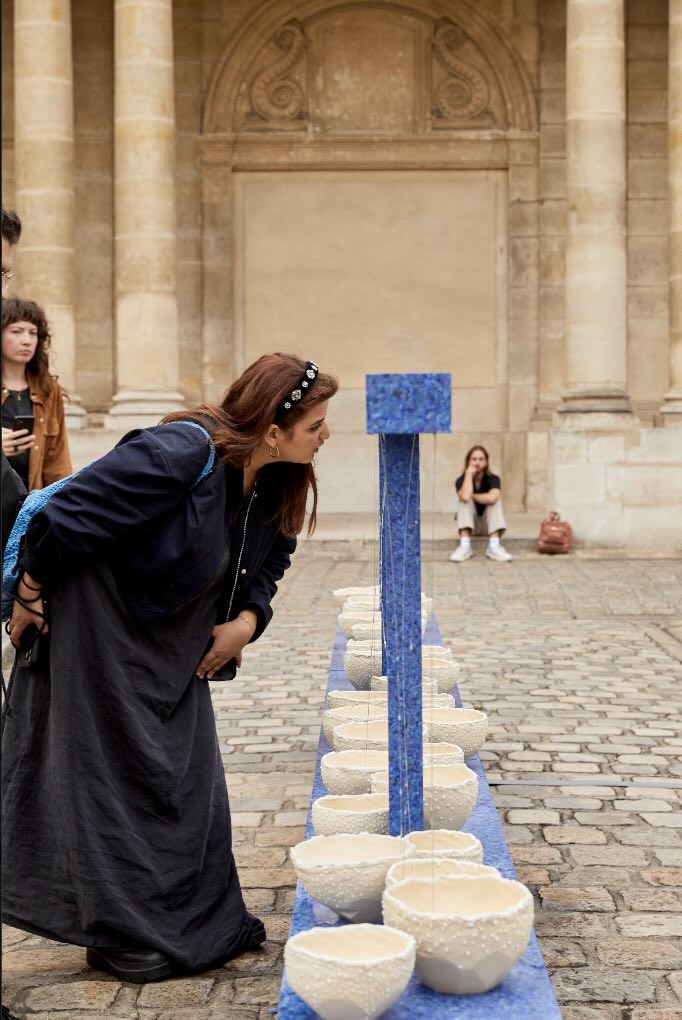
In contrast, Idéale Ivresse conjures an instant burst of joy: a sparkling note built on yuzu and Pamplewood, a molecule alternating between pink grapefruit and a woody facet, like a happiness-boosting vitamin tablet. And Miette Infinie takes lusciousness in a whole different direction. The fragrance explores a umami flavor with a sweet and savory accord of maple syrup and soy sauce, two ingredients with natural origins but shaped by humans. The four creations continue their travels to arrive at Papapa café, where they are reinterpreted as drinks and personalized pastries.
When fragrance fuses with design
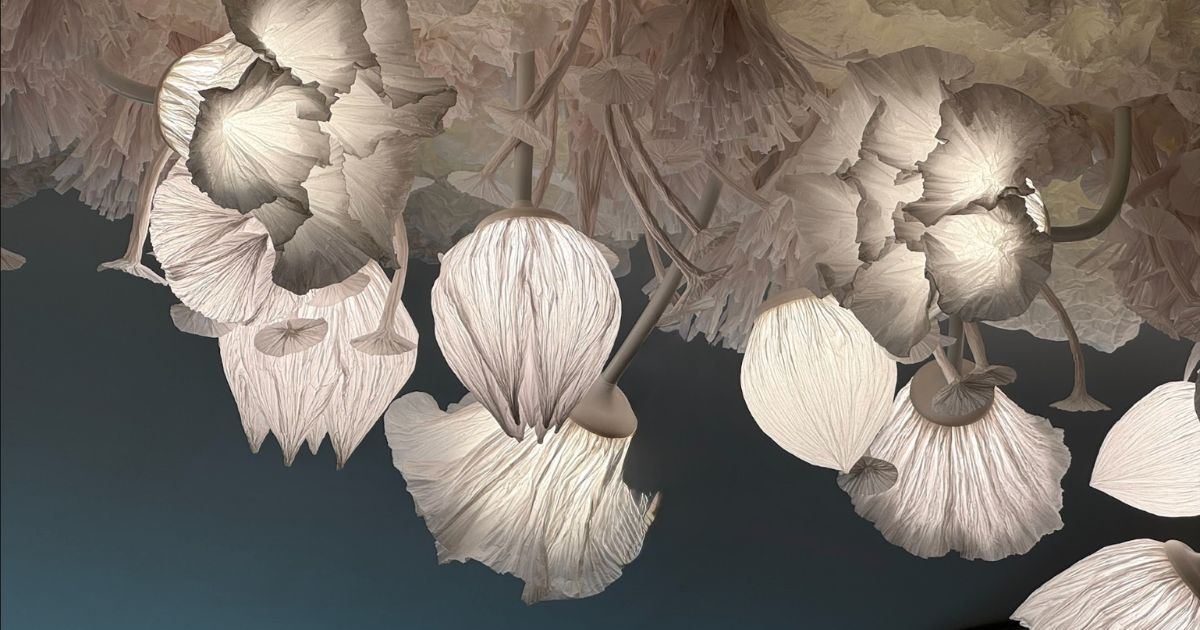
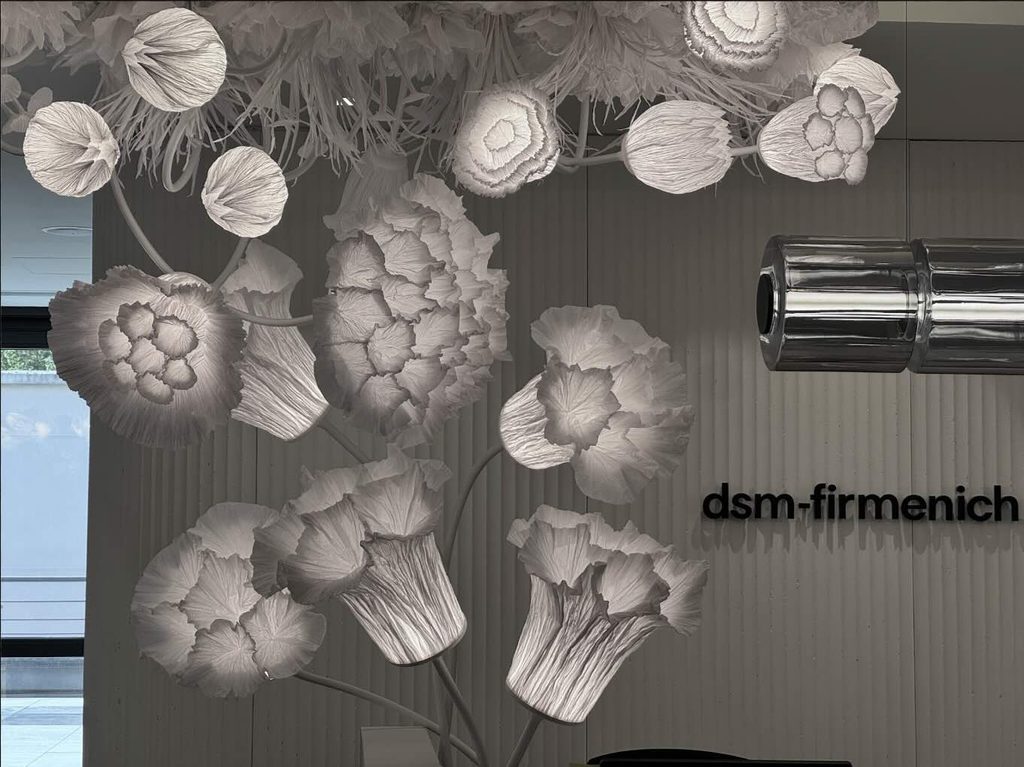
This working method goes beyond the notion of olfactory illustration alone. At DSM-Firmenich, the fragrance may become one of the work’s actual materials, on the same level as paper, stone and light. In July 2026, the immersive experience Flowers Are Watching Us orchestrated by the composition house expressed the notion in a different form. The event brought together DSM-Firmenich perfumers from around the world, along with a collective of contemporary artists including Sophie Zenon and Anaïs Tondeur, to examine the following question: what if we were to cease thinking of flowers simply as beautiful objects or cultural symbols, seeing them instead as subjects, living beings capable of adapting and reacting to their environment? French visual sculptor and designer Junior Fritz Jacquet created an in-situ installation for the occasion, where paper transformed into imaginary flowers, shimmering with light, textures and movement. Senior perfumer Amandine Clerc-Marie and perfumer Coralie Spicher responded to his creation, entitled Acropause. The artist and perfumers worked together in a collaboration aiming not to recreate an existing flower but to invent a wholly new one, resulting in Fleur de Papier. Luminous, airy, and multi-faceted, the imaginary flower centers on Heliobliss®, an exclusive new DSM-Firmenich molecule with powdery notes. At its heart lies a sun-drenched floral bouquet combining ylang-ylang flower with jasmine and Osmanthus Firgood. Then the olfactory material takes on more texture and powdery aspects as vulcanolide and muscenone deepen the delicate musk sillage. Here again, the fragrance is not simply something added post-creation. It was created hand in hand with the work of art, emerging from interactions between dampened, folded paper and the composed formulation – between a visible material and a material that can only be grasped by breathing it in.
These collaborations illustrate another way of imagining the creative process. The perfumer is no longer only responsible for translating an intention into a scent, just as the artist or designer is no longer simply content to provide a fragrance with a shape. Each creator brings their own language, materials, constraints, and intuition. And it is within this dialogue that olfaction acquires a new status: a multi-dimensional work equally capable of posing questions about the times we live in.
Anankè, Maison de Victor Hugo garden as part of Paris Design Week
6 place des Vosges, 75004 Paris
September 10 to 20, 2026
Visuals : DSM-Firmenich






Comments