Cette publication est également disponible en :
 Français
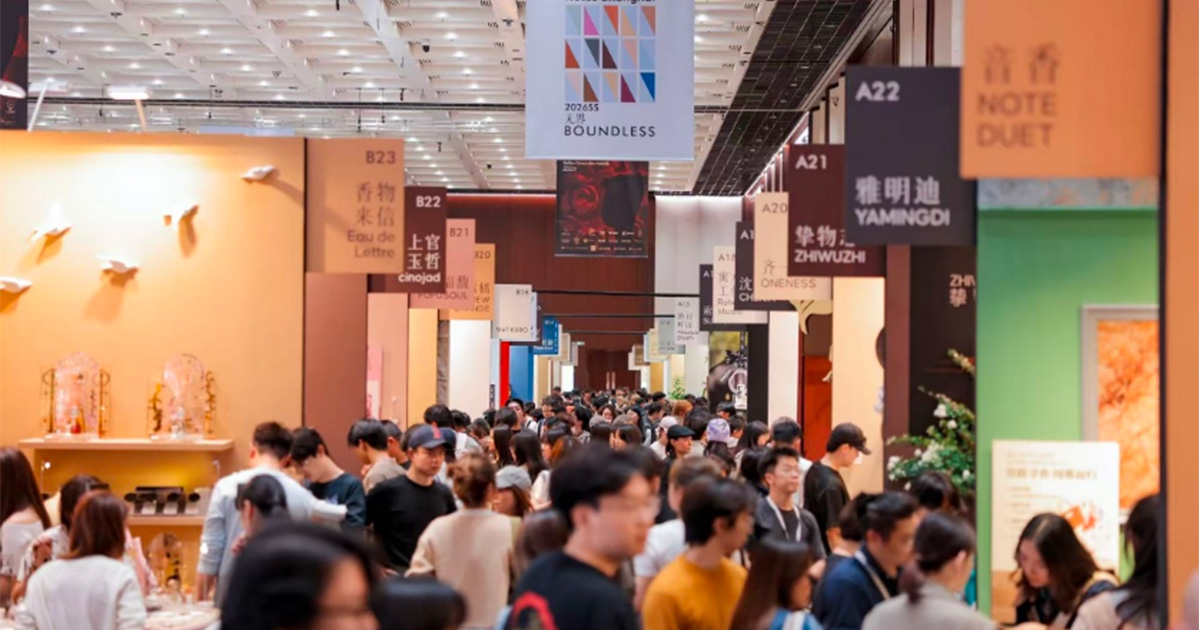
Everything moves fast in China, and the world of fragrance is no exception. Every six months in Shanghai, the Notes exhibition sees Chinese, Asian, and European brands set up shop to present their creations to an ever-growing crowd. This year’s early edition ran from April 2 to 5, 2026, welcoming very young houses (less than a year old) alongside more established names. Here is a brief overview of an exhibition that is redrawing the market’s contours.
Preamble: The digital matryoshka
Arriving at the exhibition immediately confronts you with the reality of the Chinese ecosystem. The “Great Internet Firewall” imposes its rules, and super-apps, led by WeChat, structure the entire experience. Brands, often reluctant to hand out samples directly, generally require visitors to register on their mini-sites before deigning to offer one. This creates a digital barrier for the foreign visitor, but it demonstrates the total integration of digital technology into the local consumer journey – a place where even the menu for the smallest restaurant is viewed via a QR code.
Some like It fresh
Every olfactory culture has its own grammar. With a market penetration rate of only 5% (in a market of over a billion inhabitants), fine fragrance as conceived in the West is recent in China, rooted in tastes shaped by functional products. Aromatic accords are highly favored, calling upon notes familiar to the Chinese consumer, but often perceived as exotic by the European perfumer’s palate.
Shiso (perilla) is the perfect example: this herb from the Lamiaceae family (like mint or patchouli) enjoys a popularity comparable to that of basil in the West. It is masterfully used in Chai Lee by the perfumer Damfool. Coupled with numerous green notes, the reddish herb plays a part that is at times anise-like, at times minty, delighting fans of a registry close to aromatherapy. It is, therefore, not surprising to note the local success of brands with a similar olfactory aesthetic, such as Aesop.
At the heart of fruit and nostalgia
Asia is not a culinary destination known for its passion for excessive sweetness. Ethyl maltol (the cotton candy note) and vanilla, so dominant in the West, are giving way here to herbaceous coumarin and, above all, fruity notes. Strawberry, passion fruit, and guava dominate, exemplified by launches like Tough Berry from Voice from the Sky. Composition houses are adapting: IFF, for example, presented its two new LMR natural extracts of raspberry and passion fruit.
This gourmandise also takes on a more local and comforting form with red bean paste, which gives rise to captivating accords. This reassuring note affects the Chinese public exactly as peanut butter does for American palates, highlighting another face of olfactory nostalgia – one far removed from praline.
The scent of cities: The new olfactory landscape
Before even studying the bottles, one must experience the sensory environment of these consumers. Olfactory identity starts in the streets: in Beijing, the whiffs of Peking duck and barbecue marking the exit of subway stations contrast sharply with Shanghai, an asepticized metropolis, punctuated by mass plantings of fragrant flowers like the wallflower. Above all, the most disruptive change in these megacities lies in the air and the silence: the omnipresence of electric vehicles (cars and scooters alike) has literally removed the smell of gasoline and combustion from our noses, cleaning the air of thermal pollution.
Lost in translation: The pitfall of eurocentrism
This specific landscape explains the colossal gap in tastes that Western brands sometimes encounter. Flavius Calaj, an independent Romanian perfumer, observed that very muscular compositions, heavy on pyrazines and amber woods, which are attractive in the Balkans, proved far too polarizing for a country that values discretion. The tradition of sillage is different: on public transport, few people wear a fragrance perceptible at a distance. The olfactory identity diffused in the Radisson Blu lobby, incidentally, contrasted sharply with this ambient restraint – a notable point.
For foreign creators, the challenge lies in deconstructing our French-centric paradigm. Nothing illustrates this divide better than the treatment of osmanthus. At a conference, the conclusion was inescapable: the European perfumer almost always composes using osmanthus absolute, dominated by its intensely leathery and animalic notes. The Chinese public, conversely, seeks the fresh, apricot-like, and delicate scent of the living flower that blooms in autumn. This simple example proves that a fundamentally different aesthetic approach is indispensable.
The makers of scents
To meet this highly specific demand, new profiles are emerging. While undisputed masters like Dominique Ropion made the trip – his humility contrasting with the fervor of the exhibition dedicated to him – it is the independent Chinese perfumers (Tianle Feng, Lorenzo, Damfool) who are gaining the advantage. They intrinsically master their country’s olfactory memory, a decisive asset for touching the heart of a resident of Chengdu or Guangzhou.
The other side of the coin: The power of the world’s factory
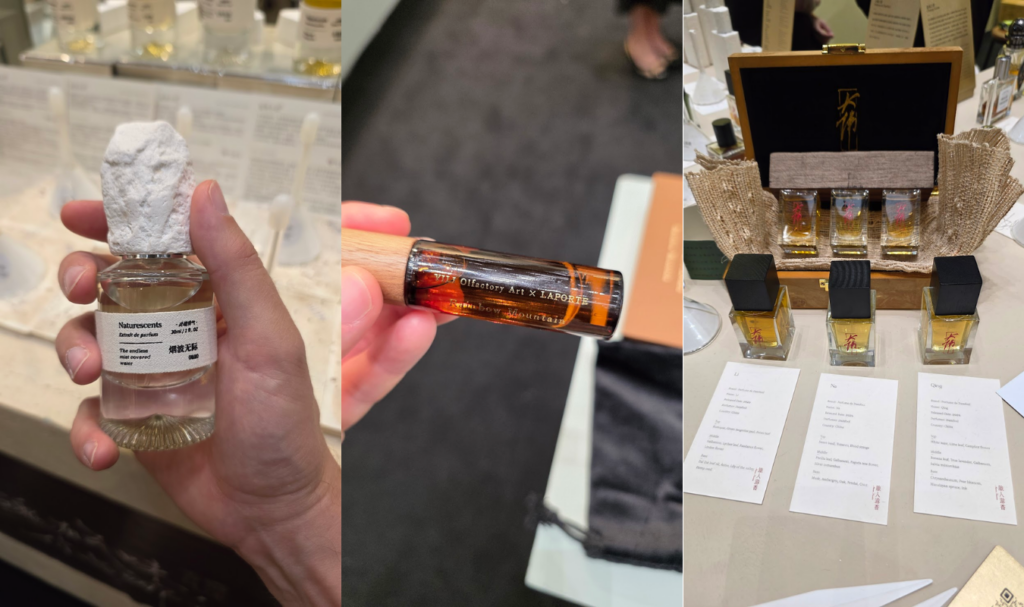
Beyond the scent itself, the real striking power of Chinese brands lies in physical execution. While their storytelling willingly draws on local mythology, their secret weapon is logistics. Being at the heart of the “world’s factory” offers these houses direct, low-cost access to an unparalleled industrial apparatus.
This proximity allows them to deploy spectacular stands: Atelier Möbius offered magnificent arrangements at a fraction of the European budget. More importantly, the packaging is extremely meticulous! Even at an accessible price point (the 30 ml format is the norm), the bottles, caps, and textures benefit from incredible care, made possible by this economic advantage. We are definitively moving away from the French niche dogma and its famous “all in the juice, nothing in the marketing.” In the age of social media, where the visual dominates, form is just as crucial as substance here, and Western brands struggle to compete with such a level of finish at this price.
What does tomorrow hold?
Leaving Shanghai, one thing is clear: the Chinese fragrance market will not settle for importing our codes. It is inventing its own, drawing on Western perfumery but with its own ingredients, its own nostalgia, and an industrial force that serves as a lesson in humility.
For industry professionals looking to establish themselves in China, the conclusion is obvious: a simple “copy-paste” of our Western formulas will only lead to limited success. Everything must be re-examined, adapted, or reinvented to satisfy these demanding consumers. We’ll meet again in October for the next edition. Until then, we’ll need to seriously rework our osmanthus accords.
Main visual: © Notes Shanghai









Comments