Cette publication est également disponible en :
 Français
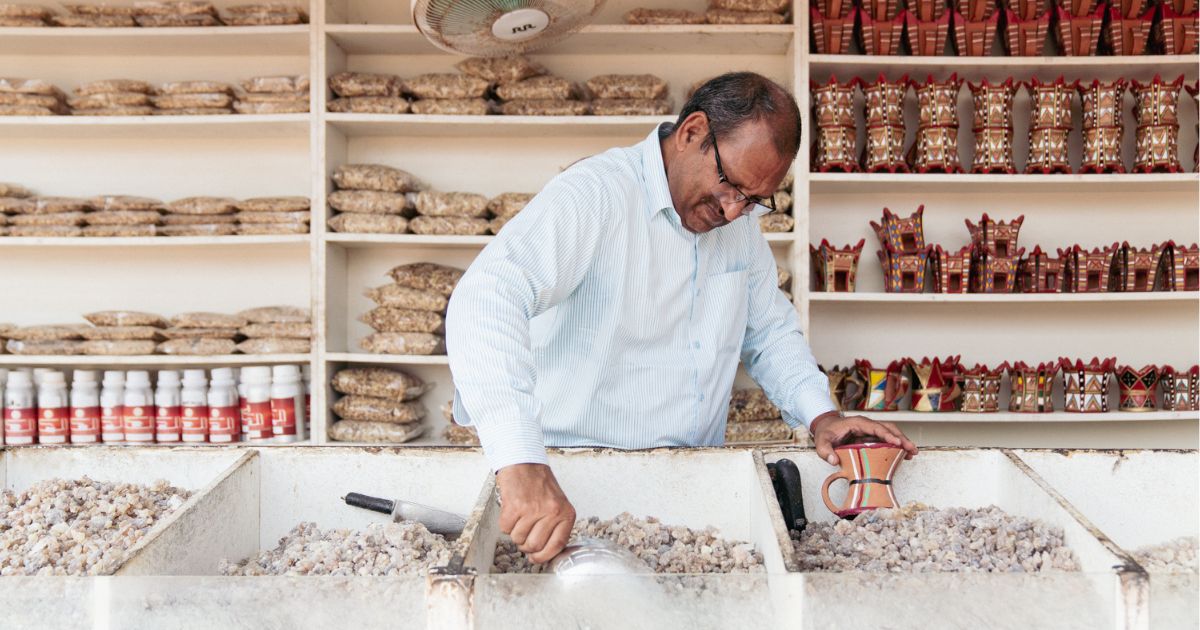
While frankincense has always been part of the changing face of fragrances, it has taken on a new role in the modern perfumery landscape. Its journey reflects both a shift in aesthetics and a change in perspective. An age-old material that has become one of the most relevant voices in contemporary niche perfumery.
Editorial partnership
The late 19th century saw perfumery entering into a new era as it embraced modernity. The arrival of the first synthetic molecules, coumarin, ionones, vanillin, nitro musks and, a little later, aldehydes, took Western perfumery in a different direction, ushering in a novel olfactory vocabulary liberated from botanical shackles. For the first time, perfumers could put together abstract creations, accords that no longer evoked natural elements. Frankincense fell out of favor in the changed perfumery landscape. Its liturgical feel did not chime with the times: The dawn of the 20th century aspired to geometric forms and stylized accords echoing the notions of emancipation, progress and the worship of technology. Perfumery turned its back on sacred traditions and pivoted to venerating hedonistic luxury.
Frankincense continued to feature in compositions, although it took a backstage role, becoming a technical tool used by perfumery in search of new languages. The material carved out an unexpected place for itself in aldehydic florals in the form of essential oils or absolutes. Chanel’s No22 (Ernest Beaux, 1922) is one of the best examples. The bouquet of white flowers with a flash of silver includes hints of frankincense blending into resins and airy aldehydes. Frankincense fulfilled the same function later on for Estée Lauder with Estée (Bernard Chant, 1968), a sparkling and spotlessly clean floral, before featuring in the century’s star ambers, fragrances that reflected a pronounced taste for an idealized vision of the East. In Shalimar by Guerlain (Jacques Guerlain, 1925), frankincense mingles with vanilla and balsamic notes to amplify their depth. Estée Lauder’s Youth-Dew (Joséphine Catapano, 1953) gave it a supporting role for the fragrance’s spicy accord, bringing a resinous feel. Jean Amic, Jean-Louis Sieuzac and Raymond Chaillan made it work even harder with Yves Saint Laurent’s Opium, in 1977, with the material introducing a tension underpinning the fragrance’s intensity and boosting its presence.
Between two worlds
In 1983, illustrious French perfumer Guy Robert composed the first two Amouage fragrances, Gold Woman and Gold Man, creations that took the aesthetic further while offering frankincense a new voice. The generous, elegant aldehydic floral bouquet of Gold Woman is rooted in a powdery, ambery base infused with the mineral clarity of frankincense. The fragrance married the codes of French fine fragrances with an iconic Middle Eastern material in a perfectly balanced composition heralding the path the house would take. The 1980s saw the rise of an effusive perfumery centering on powerful fragrances and extraordinarily punchy sillages. The boundless energy and flamboyance of a decade in love with drama and certainty then gave way to different desires, more intro- spective, possibly spiritual, certainly less materialistic. As a result, the 1990s restored frankincense’s reputation. As the century drew to a close, Serge Lutens unveiled his vision of perfumery, a vision infused with the traditions of the Arab world. He launched a series of major creations including Encens et Lavande (Christopher Sheldrake, 1996), a fragrance that bridges East and West, signaling a fresh focus on frankincense.
In 1999, the material symbolized the transition to the unsettling yet fascinating new millennium in Passage d’enfer from L’Artisan parfumeur (Olivia Giacobetti). The following year, UNESCO included the Land of Frankincense in Oman on its World Heritage List as the perfumery world explored what was fast becoming a highly sought-after ingredient. This resurgence mirrored the dazzling growth of niche perfumery and private collections launched by leading houses opting to liberate themselves from choices imposed by mainstream distributors; in other words, from gourmand fragrances and unabashedly flowery, fruity creations, a move that converged with a new appreciation for the Middle East. Frankincense was trendy and it hit the mainstream. Comme des garçons dedicated an entire collection to it in 2002, including the much-admired Incense Avignon (Bertrand Duchaufour). In 2004, Dior’s Bois d’argent (Annick Menardo) took frankincense on a journey to the heart of a block of iris, musk and Ambroxan. That was the year it also made its presence felt in Bois d’encens (Michel Almairac), one of the first fragrances in the “Armani Privé” collection. Over the years, this development opened the door to an array of creations. Various houses, such as Serge Lutens and Comme des garçons, continued to explore frankincense from a variety of different angles. Others, including Byredo, Trudon, Parfum d’empire, Guerlain and Filippo Sorcinelli, reshaped it. A new generation of brands, including Olibanum and Chapel Factory, went as far as choosing the material as their focal point, illustrating the strength of its appeal to contemporary perfumery. This very real popularity says something interesting about the times we live in.
Language and living heritage
In a world full of artificial stimulation, resins seem to offer a haven that reassures and recenters us. They evoke universal memories of heated wood, dry smoke and enclosed spaces that everyone recognizes without the need for religious references.
Members of Gen Z encounter odors that contrast with the sugary accords of their teenage years. Frankincense also offers a palpable, sometimes primal, response to the desire for density and affirmation, a desire that has been the driving force behind niche perfumery. This shift coincided with another development: The boom in the Middle Eastern market that began in the 2000s became a decisive factor for European brands as they increasingly embraced relatively uncharted olfactory traditions. The most instructive example is oud. Western interpretations of this material synonymous with the region built more and more bridges between two historically disparate fragrance cultures. The encounter transformed the standards of Western perfumery and prompted a worldwide penchant for denser signatures. This landscape offered Middle Eastern houses unprecedented export opportunities. Their fragrance culture, until then little known outside the region, aligned with an aesthetic that had become familiar.
A number of houses attracted a new international audience, including Amouage, which occupies a place of its own. Frankincense is one of its triad of signature ingredients, alongside rose and ambergris, and many Amouage creations celebrate its multifaceted nature: The Omani house’s identity is very much rooted in an ingredient that is also a form of living heritage.
In Epic Woman (Cécile Zarokian, 2009), frankincense introduces a dryness to the heart of a rose and jasmine bouquet on top of an opulent woody base. Lineage (Karine Vinchon- Spehner, 2023) reveals another, lighter, almost mineral facet of the material, underpinned by fresh spices. With Purpose (Quentin Bisch, 2023), frankincense takes a deep dive into its essential duality, beginning with a lively opening before taking on a darker density anchored in powerful woods. Meanwhile, Guidance (Quentin Bisch, 2023) features a frankincense that keeps the pear, rose, hazelnut and creamy sandalwood accord perfectly in balance. This strong connection to frankincense is also expressed in more traditional forms, through attars such as Luban Al Akhdar (Quentin Bisch, 2025). The material becomes airy, carried by citrus and aldehydic accents, while myrrh and labdanum recall its earthly roots. Perfumery has undergone many changes over the years, and frankincense, a material offering endless depth and contrast, has been there every step of the way. Amouage is writing a new and magnificent chapter in this timeless journey.
Conception & Partnership Director: Mathieu Chévara
Film Director: Eléonore de Bonneval
Videographers: Ateeb Ali, Mulook Albalushi
Video Editor: Jean-Philippe Derail
Sound design: Perfecting Sound Forever
Title design: Vianney Bureau, Mikaël Charbonnier
Amouage: Renaud Salmon, Andras Komar, Johanna Ratti, Dominique Roques, Matthew Wright, Rayyan Alabdullatif, Maria Camino
Special thanks to Arielle Lauze







Comments