
Cette publication est également disponible en :
 Français
The composition house has been training its perfumers in-house for almost half a century. What does this type of training bring to a large business like DSM-Firmenich? What qualities do candidates need? And what does a student’s typical day look like? Olivier Gurtler, Head of Perfumery Creation Excellence at DSM-Firmenich, and Martin Koh, Master Perfumer and Dean of the School, answer our questions.
This article was written in partnership with DSM-Firmenich
What leads a company like DSM-Firmenich to set up an in-house school?
Olivier Gurtler: We feel that perfumers are the heart of our business and its creativity, and we want to attract the most talented people so we can win every project. Running our own school means we have a wide variety of teams specializing in the perfumery categories we feel are promising, people with in-depth knowledge of our palette and innovations. Naturally it also helps people develop a strong sense of belonging, making it easier for them to get to know each other and creating the collaborative environment that’s so important. We use today’s skilled perfumers to train the next generation, who in turn bring their creativity and innovative ideas to the company.
Martin Koh: There aren’t really any books explaining how to create good fragrances. So if we don’t transmit our expertise to the younger generation it will be lost.
How long has the school existed?
M. K.: It was set up in 1977 by Tony Morris, who taught me. His very first student was Francis Deléamont, who created Boucheron for women.
How many students does the school currently have?
M. K.: We have twelve trainees in total, at different stages of their learning journey across three programs: fine fragrances, functional fragrances, and technical fragrances. We recruit two to four new candidates every year.
What sort of profiles do they have? What are the qualities they need?
M. K.: They need a university degree at the very least, preferably in the sciences, or to have graduated from the École Supérieure du Parfum et de la Cosmétique, ISIPCA or the Grasse Institute of Perfumery. As an international company selling our creations throughout the world, we’re looking for diversity.
Candidates have to show that they are fully committed to the perfumer’s profession and the company. Training takes a long time and represents a significant investment for DSM-Firmenich. They need to be ready to work hard, because that’s what the job demands. And they must be a team-player.
How do you recruit students?
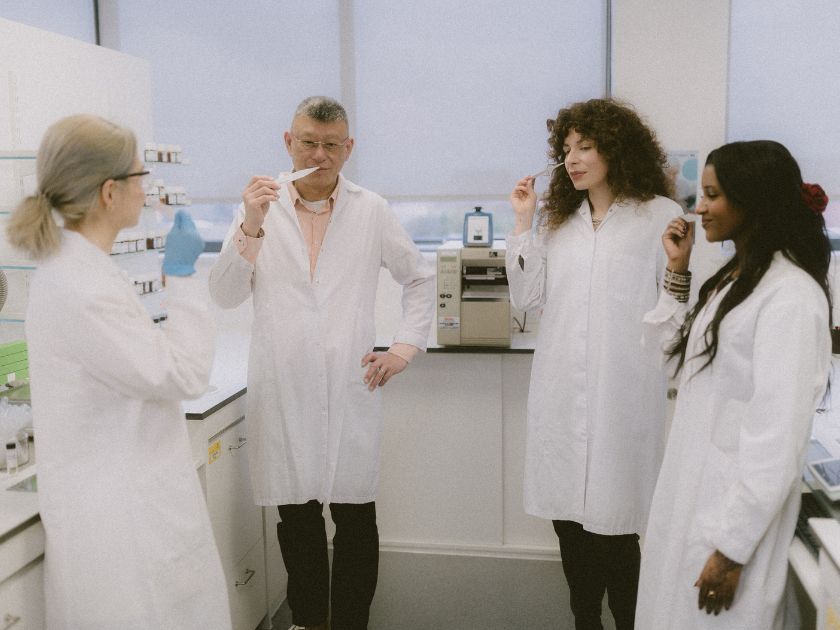
M. K.: It all begins with a smell test to make sure the candidate has a sense of smell that works well, a good olfactory memory, and the ability to recognize a raw material, spot the difference between two similar ingredients, and distinguish between powerful and discreet odors. Candidates who score at least 90% are interviewed by a committee I sit on with other perfumers and managers. We choose three to five of them who then make a presentation to the committee for the final decision. The process takes two to three months and our choice is based on several criteria: creativity of course, but also the ability to present a concept and develop it, perseverance, and soft skills.
How long does training last?
M. K.: The technical fragrances program lasts three years, while the fine fragrances and functional fragrances programs last a little longer: three and a half years for trainees from ISIPCA and ESPC, four for everybody else.
What form does teaching take?
M. K.: We don’t have a physical school or classroom lectures, we use a mentorship model with a very international outlook. Throughout the course my role is to offer support and assess their progress each term. In the foundation year, which happens in London, students learn all about the basic ingredients: they describe, memorize and use them in accords and formulas. The year ends with a key exam they absolutely have to pass to stay on the course. The second year takes place in Geneva, where the focus is on getting to know new materials, particularly our innovations, and different applications: trainees learn to create fragrances for shampoos, body lotions, shower gels, and candles.
In the third year they split into three groups depending on the program they choose and are sent to different creative centers. Fine fragrances students, for example, spend three months immersing themselves at our Villa Botanica in Grasse to learn everything they need to know about naturals, observe flower harvesting and distillation, and so on. Regarding artificial intelligence, we avoid exposing our trainees to these types of tools too early, as they need to build up a solid foundation of knowledge before being able to use them properly.
What does a student’s typical day look like?
M. K.: I tell them to start each morning by smelling the base note of the creations from the day before on a scent strip. We give them exercises to do for the rest of the day: they have to create accords, learn to handle new ingredients, and so on. On top of their technical training, they also learn what a perfumer’s life is really like. And a very important part of our mentorship relationship is the bond created between us, which can lead to collaborations later on.
O. G.: I feel that soft skills are almost as important as technical expertise. From the outside it may look like perfumers lead magical lives, spending their time receiving prizes while sipping champagne. In fact 95% of the time they are in the office with evaluators coming to ask them to rework their notes: “This note isn’t fresh enough,” “This fragrance doesn’t align with the client’s budget,” “This fragrance isn’t stable and changes color,” “This isn’t the direction the client wants to go in.” Learning to be resilient is essential, especially for youngsters joining a big house where they are competing with lots of master perfumers for each project.
What happens to students once they’ve finished their training?
M. K.: It’s a moment they’ve been eagerly awaiting! They learn to stand on their own two feet and go to work at our creative centers where they are needed. This new phase in their learning journey is a moment of truth: they have to fit into a team, establish themselves, and win projects.
Martin, what aspect of running the school do you particularly enjoy?
M. K.: When I started out I didn’t know anything about the industry, not really a surprise in Singapore in the 1980s. It still warms my heart that DSM-Firmenich trusted in me and opened the door to this fascinating, marvelous world. Thirty-seven years later I’m still here, and it’s very important for me to transmit the heritage I received to the younger generations. I’m always happy when a former trainee tells me that one of their fragrances has been launched on the market. And I have to say that I learn from my students too. They smell an ingredient and tell me “Ah, I could use it to do such-and-such”, and sometimes it will be an idea I’ve never thought of myself. That’s always an inspiring experience.
Could you cite some of the perfumers who have attended the school?
O. G.: The first one I’d like to mention is of course Martin Koh, who is such a great example of a master perfumer who is extremely successful in functional fragrances. In this field, which often gets less attention than fine fragrances, I could also cite François-Raphaël Balestra and Haresh Totlani, as former students who are now master perfumers. François-Raphaël works on developing new ingredients, and Haresh not only wins numerous creative projects around the world but also helps us develop new fragrance-related technologies in collaboration with our researchers in Geneva. And I’d conclude with three of the leading lights of fine fragrances: Alberto Morillas, Marie Salamagne and Daphné Bugey – you’ve probably heard of them!
To learn more and explore student experiences, you can watch the web series here!
Visuals : DSM-Firmenich






Comments