
Cette publication est également disponible en :
 Français
One January night in 2023, Gaetano Pesce is visited by the image of a frankincense tree he has never seen, but which he sketches as soon as he wakes, and which will become the Wadi Dawkah logo. From this vision will emerge the Oman Collection, the ultimate dialogue between synthetic and natural resin, a gift to the worlds of design and perfumery.
Editorial partnership
January 2023. It was a crisp morning in SoHo, Manhattan, just as winter mornings in New York can be. The creative studio of the polymath Gaetano Pesce, then 83 years old, filled the winter grey cityscape with colour. Gaetano had led a life rich in movement, challenge, and artistic milestones. Born in La Spezia, Italy, in 1939, he had lived in Paris, Venice, finally moving to New York in 1983. His work had been one of constant provocation: challenging the status quo, questioning received truths, blurring the boundaries between art and design, between the meaningful and the purposeful. He had always been a man of the city. He thrived in urban environments, and had always held a deep, almost fearful respect for nature. He recognised its power, its immensity and unpredictability. The urban cosmos offered him his comforting space, among the geometrical shapes of the city, its density and the diversity of people composing it. But that particular morning, he had woken up from a dream of a different kind. It was a silhouette, a natural silhouette, with a very specific shape. It wasn’t anything human-made.
That night, Gaetano had dreamed of a frankincense tree.
He rushed to the studio with a quick sketch of the shape still fresh in his mind, his restless imagination already building new possibilities. He did not know it yet, but he had just drawn the genesis of what would later become the logo of Wadi Dawkah.
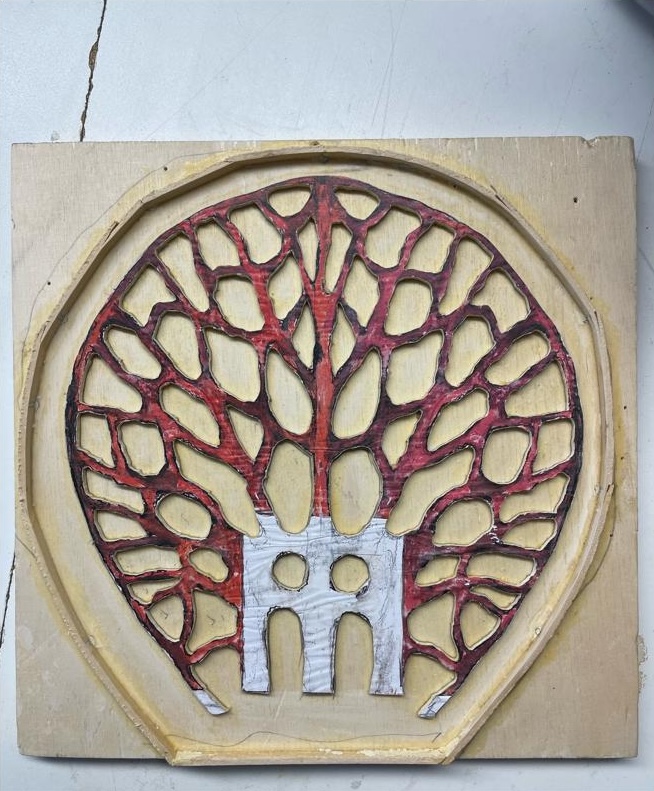
The extraordinary thing about this was that Gaetano had never seen a frankincense tree in his life. Not a real one, not even a photograph of one. His only contact with it had been through smell: a bag of frankincense resin received by post. The scented package had arrived at his office in SoHo with an unexpected message from the creative director of a High Perfumery House from the Sultanate of Oman: Amouage. Renaud Salmon, a long-time admirer of Gaetano’s work, knew that the artist was an expert in synthetic resin: a material central to his practice, which he had relentlessly experimented with throughout his career. Yet the artist had never encountered this particular natural resin before. With the package, there was no specific request, only a suggestion of a possible contamination between two adjacent worlds: the natural resin and the synthetic one. The team opened the package, and the terpenic notes of frankincense immediately filled the air, bringing a faint trace of Oman into the Manhattan studio. He was vividly struck by that scent. The sense of olfaction had always been central to Gaetano’s work: for him, smell could provoke in a deeper way than sight ever could. He quickly realised that the scent of frankincense, which he had only ever associated with church, was opening the door onto a new path. He asked his collaborator Alessandro Byther, Trustee and Head of Production at Gaetano Pesce Studio, to begin experimenting: “Play with it a bit, see what we can manage to do.” Alessandro later recalled his first encounter with the material as extremely challenging from a design perspective. He remembered being captivated by its spectacular scent, but unable to understand how to work with it: “I hadn’t realised how much the resin would stick to the material; I couldn’t manage it. It becomes liquid for a short while, but then turns sticky… those first tests didn’t produce anything.” But a few unsuccessful experiments were never enough to stop an artist’s pursuit of creation. Certainly not enough to stop Gaetano Pesce and his team.
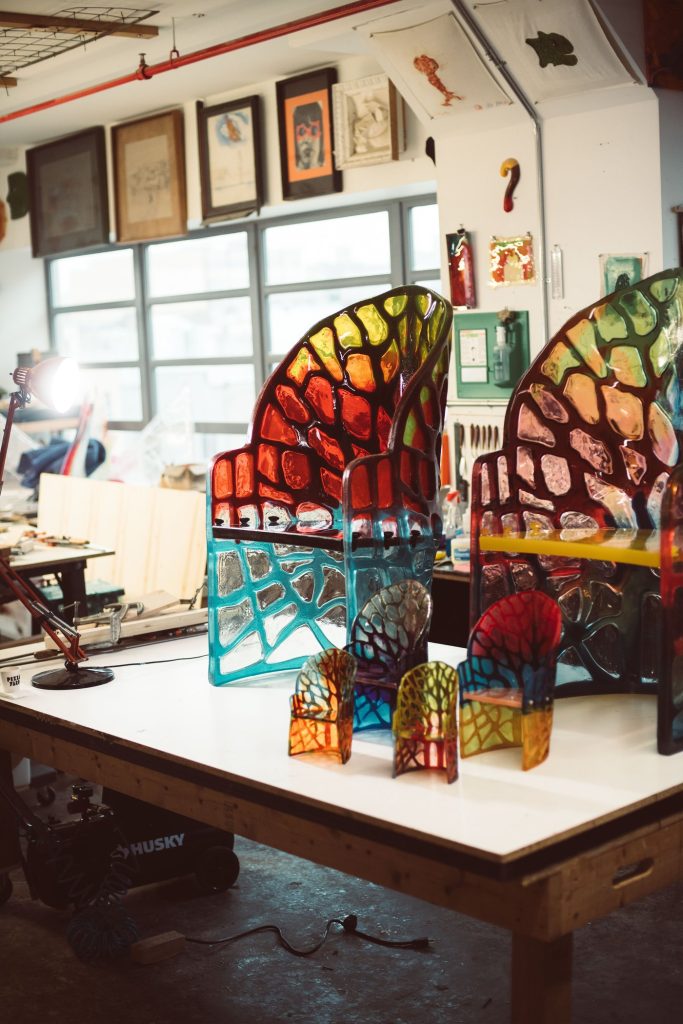
They turned to the hand-drawn silhouette of the tree he had dreamt about: “We need to find a way to apply this silhouette to furniture. We could apply it to a chair,” Gaetano told his team. A wave of creative experiments was about to begin. They began working with the synthetic resins in an innovative and challenging way. They bent the resin in a way it had never been bent before at that thickness. Finding the right timing was delicate: as it catalyses, it becomes hot and increasingly rigid. Too early, and it deforms; too late, and it becomes too hard. They managed to create a first piece with this method: the first Oman Chair was born. During the process, another innovation had taken place: frankincense resin was added to the chair, as an experiment. They were not sure if the scent would survive once the piece was finished. It turned out that the smell of industrial resin is far stronger; however, if warmed by body temperature, a hint of frankincense fragrance would emerge. Today, the Oman Chair with Frankincense stands as a testimony to that creative journey at the intersection of design and natural ingredients. Gaetano had not waited for any clear request, brief, or direction. That resin package from Oman, his dream, and his first conversations with Renaud were enough to spark his creativity. Perhaps this is true radicality: creating outside of a brief, because it simply has to be done. Creating from inevitability.
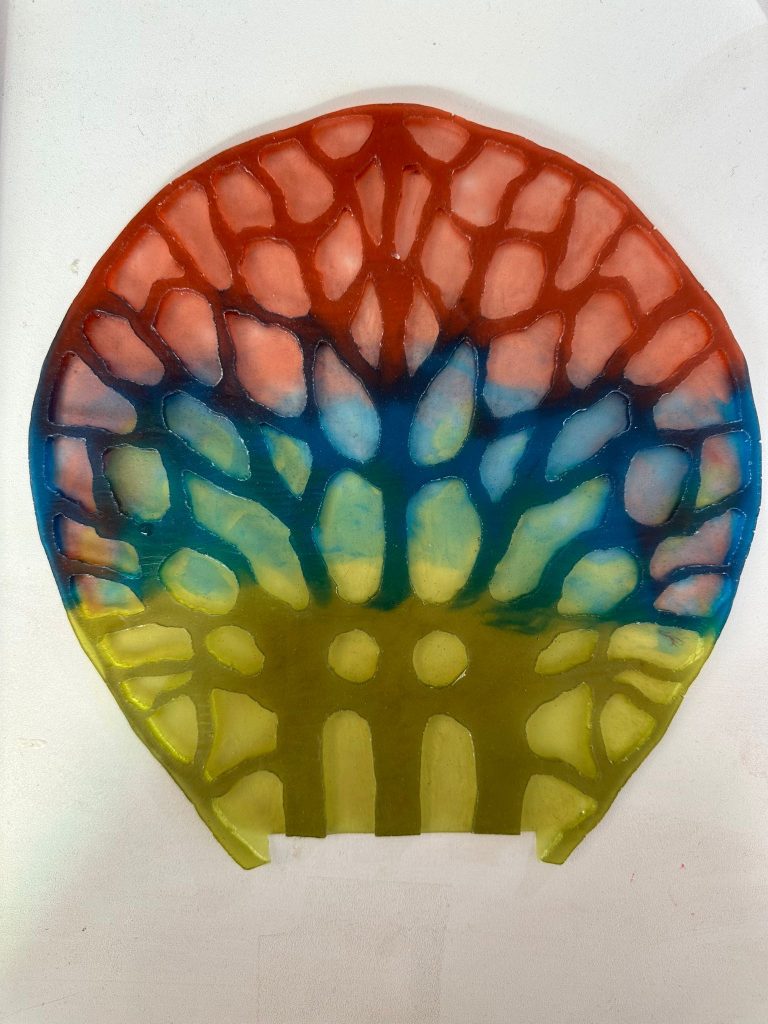
During the months that followed, more pieces were created using his signature colour palette, blending primary colours and bringing complementary nuances to life with complete transparency: a throne, a cabinet, and two lamps infused with one of Amouage’s perfumes. Later came the Oman Chair Cappuccina, a smaller piece with the jagged edges, which introduced another phase of experimentation: a dual-resin process. They combined for the first time, during the casting, two polyurethanes: a resin and a rubber. Their aim was to find the right balance between rigidity and elasticity. Along the curved edge of the chair, the thickness reaches about two centimetres on one side before tapering down to, roughly, half a centimetre at the top. The resin remains rigid at the centre, while the edges are made of a flexible polyurethane rubber. Since both belong to the same material family – polyurethane – the two components bond together naturally, without separating. The idea was to see whether it would be possible to bend and shape the seat, while creating an edge that would feel soft to the touch yet remain structurally rigid enough for seating. A chair that is more flexible and soft in the backrest area, and more rigid and stable in the lower part. It worked.
While experimenting on what would become the Oman Collection, Gaetano felt that one major piece of the creative puzzle was missing. He still needed to go to Oman: to see with his eyes, smell with his nose, feel with his heart. He wanted to see the frankincense tree that he had only ever encountered in his dreams, to touch it, and to listen to the sound of its leaves.
Gaetano and his team visited Oman in April 2023. After a stay in Muscat, they headed south, to Wadi Dawkah. Giulia Tosciri, Director of the Gaetano Pesce Studio, remembers how surprised the whole team was to see him so happy and serene in such a vast, desert landscape, as he had always shown some reticence toward untouched nature and large open spaces. It was unusual to see this contemplative reaction in someone so profoundly urban. In Wadi Dawkah, Gaetano had felt the deep connection of the Omani culture with this place, its natural and cultural heritage. In that open and peaceful space, he was visibly moved, already projecting forward, his mind racing toward what could be made there. In that moment, he sensed that something important was possible. On the plane home, he was already sketching the next steps.
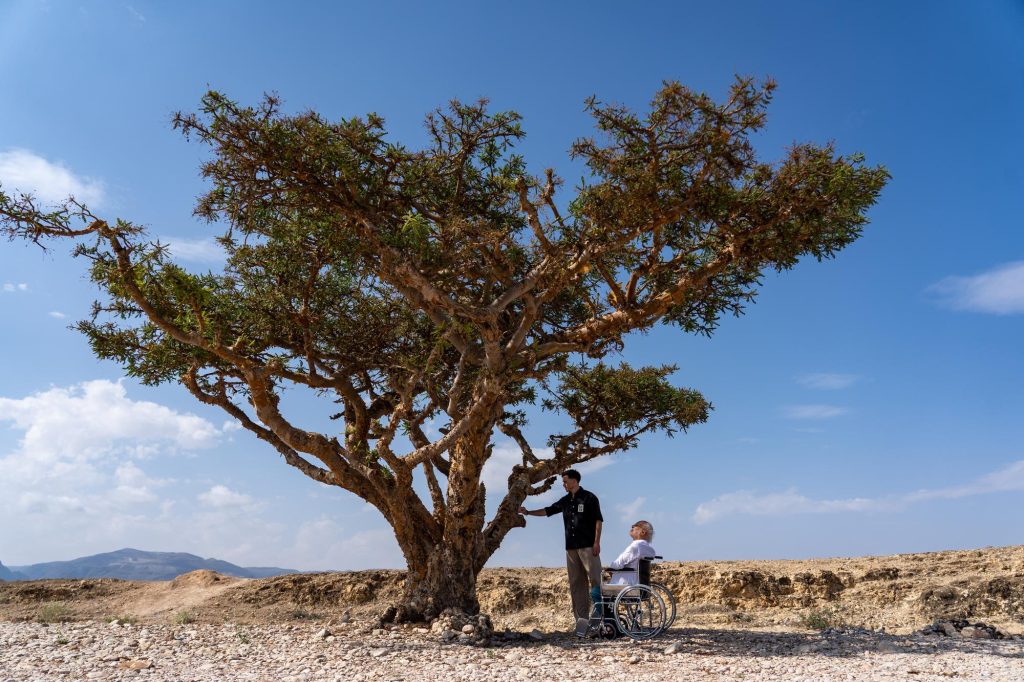
The journey to Wadi Dawkah was Gaetano’s last trip. He passed away one year later, in April 2024. And yet, his legacy lives on, as does his bond with that place. It lives among the trees, among the memories and, most of all, within the Wadi Dawkah logo. Based on that first sketch, it still carries the impertinent smile of the artist. The three artworks – the Oman Chair, the Oman Throne, and the Oman Chair with Frankincense – will finally find their home within Ayn Dawkah, displayed close to the landscape that inspired them. Through inspiration, experimentation, and Pesce’s characteristic audacity, the three pieces of the Oman Collection stand as distinct elements, each embodying a different phase of the creative process. And yet, together, they constitute a touching, harmonious whole: one of Gaetano’s last gifts to design, to perfumery, and to the synergy born from diversity. And on the other side of the world, in the New York studio, Giulia and Alessandro pass by the perfume-infused lamps every day. A wisp of frankincense drifts through the air, as if it were a reminder that the story has not ended. The experimentation that began when Gaetano Pesce was still alive continues to unfold.
Photo credits: Amouage, Renaud Salmon, Gaetano Pesce Studio









Comments