Cette publication est également disponible en :
 Français
Tracing the history of the frankincense tree through images allows us to follow how humans have perceived, utilized, and imagined it over millennia. From ancient reliefs to botanical plates, these representations tell a story that is as much cultural as it is natural.
The snaking trunks of Boswellia sacra trees pierce the skies above the vast rocky expanse of Wadi Dawkah. Their shapes seem to attest to the effort required to tear themselves from the rock and draw scarce water from the depths before undulating toward the light. Some of the twisted trunks are capped with a low, flattened crown. Others branch out from the ground in an inverted cone creating the impression of ten trees rather than a single specimen. Their papery bark curls to form fine scales in black, brown and yellow. Wounds and cuts inflicted by herbivores and humans exude a milky white resin that turns into translucent tears as it solidifies. Small, hardy leaves with an odd number of leaflets are arranged at the end of the branchlets. The flowers are inconspicuous, with five pale-colored petals and ten yellow stamens. The small fruits produced by the flowers form light-green clusters that turn brown during dehiscence. This is how we might attempt to paint a picture of the southern Arabian frankincense trees that humans have prized so highly for thousands of years. Strangely enough, very few accurate representations of these unique and precious trees have been handed down to us. Studying the history of Boswellia sacra in images means venturing into unknown territory, into a place where uncertainty and inaccuracy concerning the trees’ appearance hold sway. In other words, a place where facts are hard to come by and imagination often has to step in1This study does not claim to be exhaustive. It is a preliminary investigation into a subject that could only be explored in more depth by calling on a great many additional sources that are not all available online, and were therefore difficult to access for the purposes of this article..
Trees from the Land of Punt
(Source: Wikimedia Commons)
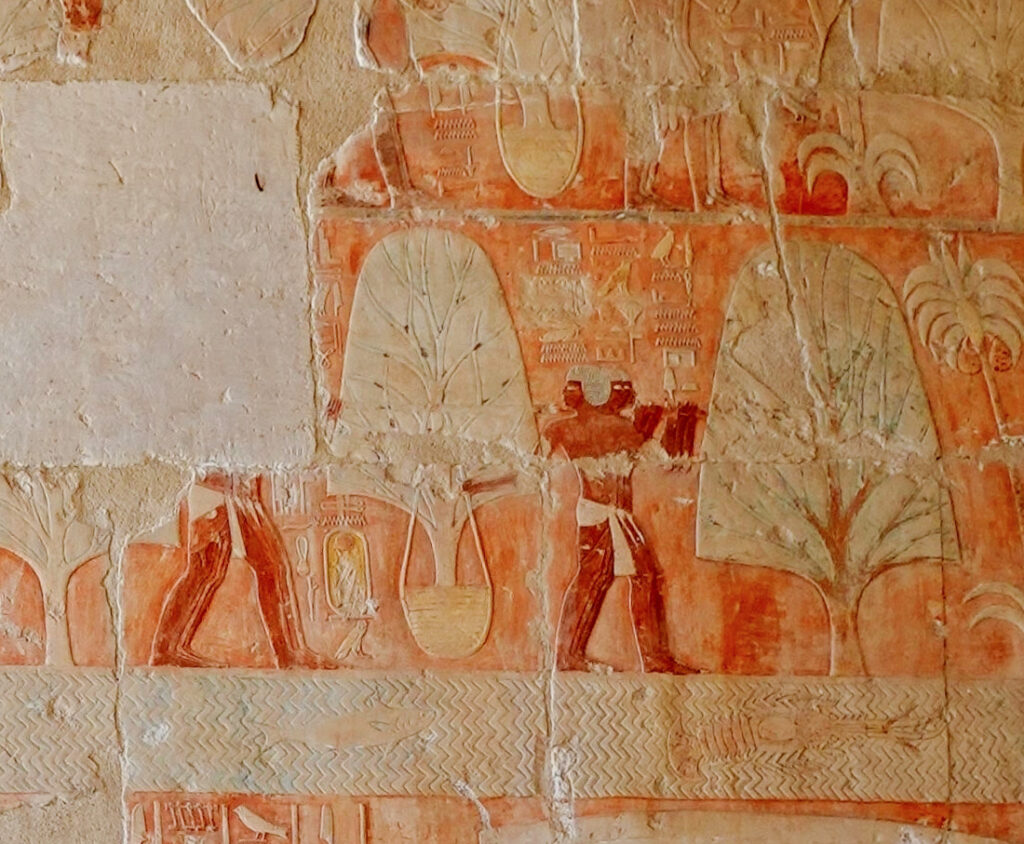
The trees depicted on the Punt reliefs at the Deir el-Bahari mortuary temple in Egypt were long identified as Boswellia. The reliefs commemorate the expedition organized around 1473–1458 BCE by Queen Hatshepsut to the faraway Land of Punt (Pwn.t), home of olibanum, myrrh and other goods highly prized in her kingdom. While the exact location of the ancient land of frankincense is still debated, most experts situate it in the northern part of the Horn of Africa2Kathryn A. Bard and Rodolfo Fattovich, Seafaring Expeditions to Punt in the Middle Kingdom, Leiden, Brill, 2018, pp. 156–175. https://doi.org/10.1163/9789004379602_008 or the west coast of modern-day Yemen3Frédéric Servajean, “Aromates et parfums d’Egypte” [Aromatic Substances and Perfumes of Egypt], in Senteurs célestes, arômes du passé. Parfums & aromates dans l’Antiquité méditerranéenne [Divine odors, aromas of the past. Perfumes & aromatic substances in Mediterranean antiquity] (Lattara archaeological site – Musée Henri Prades, June 20, 2024 – February 3, 2025), Frédéric Servajean and Diane Dusseaux (eds.), Gent, Snoeck, 2024, p. 22.. We know that the Egyptians returned from the trip laden with riches, including aromatic resins and living specimens of resin-producing trees to be transplanted in the Karnak temple to honor the god Amon4Although we know a great deal about the voyage arranged by Hatshepsut thanks to the wealth of iconographic and epigraphic documentation on the southern gate of Deir el-Bahari, it is just one of the fifteen or so expeditions to Punt organized during just over a thousand years of Egyptian history. (Frédéric Servajean, “Le pays de Pount et la quête des aromates” [The Land of Punt and the quest for aromatic substances] in Parfums d’Égypte. Du pays de Pount aux rives du Nil [Perfumes of Egypt. From the Land of Punt to the Banks of the Nile], (the Egyptian Museum in Cairo, December 1, 2024 – February 28, 2025), Hanane Gaber and Frédéric Servajean (eds.), Gent, Snoeck, 2024, pp. 164–167.).
Some of the scenes on the reliefs depict Puntites transporting several specimens in pots or baskets toward the river bank while Egyptians load them onto their vessels. The trees are then shown arriving in Egypt; firstly during the inventory of the riches brought back from Punt, then as planted trees thriving in the soil. But Egyptologists entertain some doubts: Are the trees with their snaking, many-branched boughs – also represented at a later date on the tombs of Puyemrê and Rekhmirê5D. M. Dixon, “The Transplantation of Punt Incense Trees in Egypt”, in The Journal of Egyptian Archaeology, Vol. 55, August 1969, pp. 55–65. – Boswellia or actually Commiphora?6Abdel-Aziz Saleh, “Some Problems Relating to the Pwenet Reliefs at Deir el-Bahari”, in The Journal of Egyptian Archaeology, Vol. 58, August 1972, pp. 140–158. A number of elements seem characteristic of both genera while others are stylized in the tradition of Egyptian artistic conventions7“Egyptian trees are depicted in an entirely conventional manner, but, in the case of a large picture where even the species of the tree represented has an important role, Egyptian artists almost always tried to reproduce the main characteristics as a minimum, stylizing them slightly according to their usual methods.” (Gustave Jéquier, “Lieblein, J., Le mot anti n’indique pas myrrhe, mais encens, oliban. Christiania Videnskabs Selskabs Forhandlinger for 1910 n° 1” [Lieblein, J. The word anti does not mean myrrh but frankincense, olibanum. Christiania Videnskabs Selskabs Forhandlinger for 1910 no. 1], Sphinx : revue critique embrassant le domaine entier de l’égyptologie, 1912, no. 16, p. 24.), making formal identification impossible. The confusion is heightened by the fact that trees on the Puntite reliefs take two forms: Some have luxuriant foliage with each leaf clearly drawn, while others only show pointed branches and the outline of the foliage. Are these separate species or, according to the most widely accepted hypothesis, the same species in two different states, dormant then flourishing?
The text accompanying the images offers little by the way of clarification. The term sénétcher (or snṯr) is usually interpreted by Egyptologists as referring to resins produced by trees in the Boswellia genus, while the word ântyou (or ‘ntyw) is thought to mean myrrh.8Frédéric Servajean, “Aromates et parfums d’Egypte” [Aromatic Substances and Perfumes of Egypt], in Senteurs célestes, arômes du passé. Parfums & aromates dans l’Antiquité méditerranéenne [Divine odors, aromas of the past. Perfumes & aromatic substances in Mediterranean antiquity] (Lattara archaeological site – Musée Henri Prades, June 20, 2024 – February 3, 2025), Frédéric Servajean and Diane Dusseaux (eds.), Gent, Snoeck, 2024, p. 22. The latter term is the one most frequently associated with the trees and resin masses depicted on the Deir el-Bahari reliefs, leading some Egyptologists in the first half of the 20th century to suggest that the word ‘ntyw actually refers to olibanum and the tree that produces it.9Jens Lieblein, Le mot anti n’indique pas myrrhe, mais encens, oliban, Christiania Videnskabs Selskabs Forhandlinger, 1910. [The word anti does not mean myrrh but frankincense, olibanum. Christiania Videnskabs Selskabs Forhandlinger for 1910]. Nevertheless, more recently, Frédéric Servajean opined that ntyw does in fact mean myrrh, which is easier to obtain in large quantities since Commiphora myrrha trees usually grow closer to the coast than Boswellia. The trees depicted are therefore more likely to be myrrh trees.10Frédéric Servajean, “Les pays des arbres à myrrhe et des pins parasols. À propos de Tȝ-nṯr” [Lands where myrrh trees and umbrella pines grow], EniM 12, 2019, pp. 87–122. With no new evidence coming to light, the exact nature of these spectacular trees remains in doubt. This uncertainty is compounded by the possibility that taxonomic groups now considered distinct were not differentiated in Pharaonic times.11Jesus Trello, “The incense distribution scene in TT 39 – redistribution of economic goods to Deir el-Bahari and other locations in Western Thebes”, in Polish Archaeology in the Mediterranean, Vol. 30, no. 1, 2021, pp. 157–186.
Manuscripts from the Byzantine and Islamic worlds
(Source: Spencer Collection, The New York Public Library)
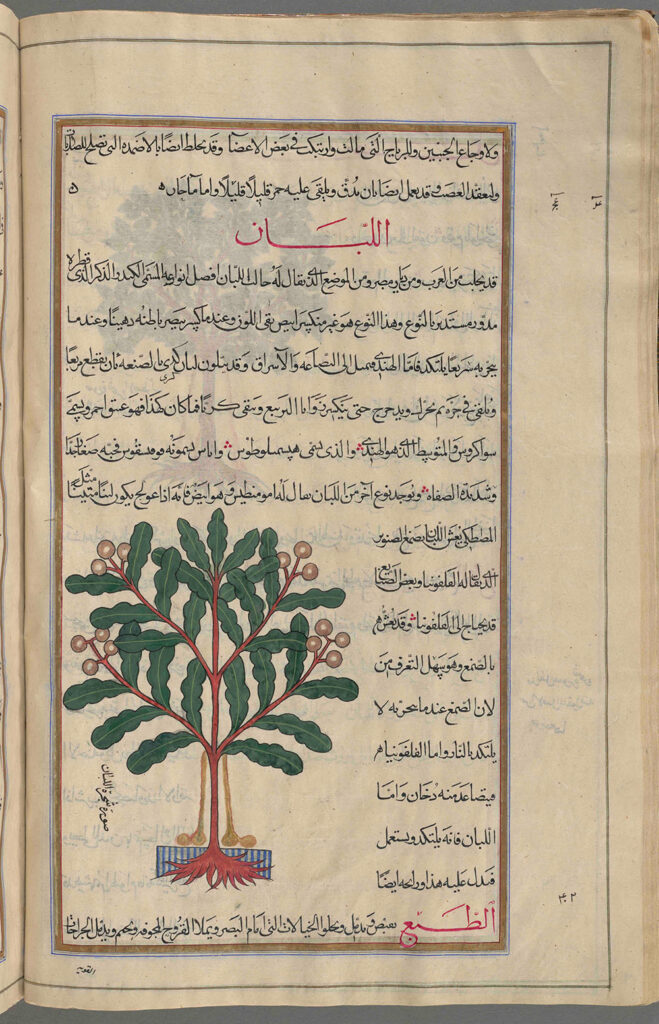
While Egyptian bas-reliefs leave room for a great deal of uncertainty, a number of medieval manuscripts make it possible to identify the frankincense tree with far greater accuracy, including some of the first depictions in various copies of ancient medical treatises, such as Dioscorides’s De materia medica. The first-century Greek doctor and botanist recommended using the bark of the frankincense tree and olibanum resin to treat various ailments.12In chapter LXX, Dioscorides writes: “[T]he bark of frankincense is burnt and produces smoke, with the scent of a pleasant odor. The bark burns in the same way and has the same virtues as the frankincense.” (English translation of Martin Mathée’s French translation, The six books of Pedanius Dioscorides of Anazarbus on medicinal matters, translated from Latin to French. To each chapter are added certain very learned annotations, collected from the most excellent doctors, ancient and modern, Book I, published in Lyon by Balthazar Arnoullet, 1553, p. 38.) The image of a Boswellia tree accompanied by two baskets containing tears of solidified resin thus feature in a Byzantine version of his influential treatise (ms. M.652, fol. 230v) from the mid-10th century.13The subsequent folio (231R) also features an illustration of the bark and the resin itself in a basket. The tree is shown as a schematic representation with long dark-green needles that bring to mind the Pinaceae rather than the Burseraceae family,14Understandably, since the resin-producing trees familiar to an illustrator in the Constantinople region would very likely have been members of the pine family. A great many Europeans, from Marco Polo to Linnaeus, also confused the frankincense tree with a conifer. accompanied with a caption that reads, “olibanum manna” (ΛΙΒΑΝΟΥ ΜΑΝΝΗ).15The Greek word used here, ΛΙΒΑΝΟΥ or, in standardized lowercase, λιβάνου, which means both olibanum and the tree that produces it, is the genitive of the word λίβανος, transliterated as libanos, itself derived from the Semitic root lbn (the basis for terms linked to milk or, more broadly, the white color associated with it) which is also the origin of the Arabic word lubān (لبان), the Hebrew term ləḇōnā (לְבוֹנָה) and the English “olibanum.” The Greeks referred to resin-producing regions (thurifera regio, from the Greek thus, “substances used for burning”) in southern Arabia with the expression Libanotophoros ( λιβανωτοφόρος), i.e., literally “producing olibanum.”
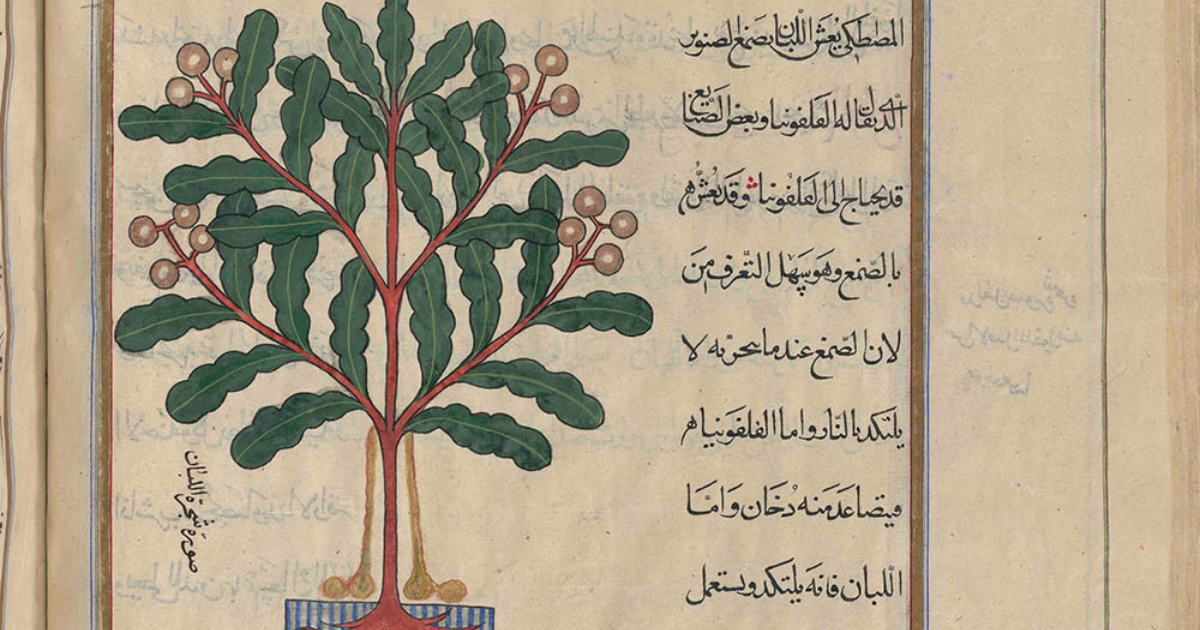
Boswellia sacra also features in a number of Arabic translations of the original Greek text, such as in the Kitāb al-Ḥašāʾiš fī hāyūlā al-ʿilāg ̌al-ṭibbī (ms. Or. 289, fol. 16v) illustrated by an artist from Samarkand around 1083. Interestingly, the artist did not depict the resin but focused on the tree’s other characteristics: knots on the trunk, the crenate-serrate shape of the leaflets margin, and the fruit, depicted as yellowish-brown spheres clustered at the end of the branches. Despite the highly stylized technique, particularly in terms of the general shape of the tree, these striking features denote either first-hand knowledge of the plant or, at the very least access, to relatively accurate sources describing its real appearance. The same features were used by scribes working on several other Arab manuscripts of De materia medica, who occasionally added a yellow liquid flowing down each side of the trunk as well as a woven mat placed at the foot of the tree (BnF, Arab ms. 4947; McGill, ms. 7508; NYPL, Persian ms. 39). This approach to representing the tree can also be found in a Seljuk16The Seljuk Empire, or Great Seljuk Empire, was a medieval, culturally Sunni Muslim empire stretching from Anatolia and the Levant in the west to Hindu Kush in the east, and from Central Asia in the north to the Persian Gulf in the south. It peaked in the late 11th century. version of another ancient pharmacological work, The Book of Theriac, dating from 1199 and preserved under the title Kitāb al-diryāq (BnF, Arabic ms. 2964), pointing to the existence of a specifically Islamic iconographical tradition concerning the frankincense tree in medical literature.17None of the illustrations in Western manuscripts feature these characteristics. Western artists, unfamiliar with details of the tree’s appearance, tended to characterize it by depicting resin in the form of tears. The rest of their representations bear no resemblance to reality. By a process of comparison we can therefore assume that at least some of the illuminations found in Arabic manuscripts were based on depictions of the tree taken from nature by artists from the southern Arabian Peninsula. However, there is still a need for an exhaustive study of these representations in medieval Arabic medical literature.
However, in certain encyclopedic works the frankincense tree loses some of its distinctive features: Fruit and resin disappear; leaves are formless; and only the branching of the trunks starting at ground level seems to lend the image a vague connection to the actual tree. This is exemplified by several illustrated versions of the famous 13th-century ʿAjā’ib al-makhlūqāt wa gharā’ib al-mawjūdāt by al-Qazwīnī. In the 1537 Persian version held in the National Library of Medicine in the United States (ms. P1, fol. 152b), the 17th-century version illustrated by Deccani’s paintings at the British Library (ms. OR 162, fol. 273r), and the 1717 Ottoman copy at the Walters Art Museum (ms. W.659, fol. 216a), only the text makes it possible to formally identify Boswellia. While the growing trend for stylization could be attributed to the fact that, unlike pharmacopoeia, these works were not designed specifically for a proper identification of the plants shown in them, it is also possible that scribes simply had no idea what this exotic tree looked like since they had no real-life models to work from.
Medieval and pre-modern Europe
(Source: Historical Medical Library of The College of Physicians of Philadelphia)
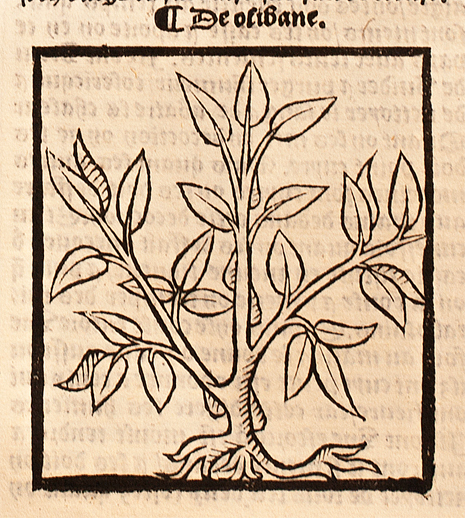
The earliest European attempts at representing the tree in illuminated manuscripts on medicinal herbs can be traced back to the 13th and 14th centuries. For instance, an almost unrecognizable illustration features in the Egerton 747 manuscript of Tractatus de herbis (circa 1280–1350). At the bottom of folio 071r, the tree labeled as Olibanum looks more like an olive tree, with a thin trunk topped by simple, slender, linear leaves.18Whereas, as you may recall, Boswellia sacra has compound odd pinnate leaves. The confusion possibly arose from one of Pliny the Elder’s descriptions in his Natural History: “It is well known that it has the bark of a bay-tree, and some have said that the leaf is also like that of the bay” (Book 12, XXXI, translated from the Latin by H. Rackham, 1952). In actuality, it is the leaves of the oleander and the olive tree that have a relatively similar shape. Pliny further asserted that it is often impossible to recognize plants based on drawings in illustrated herbals which, even in his era, were usually made up of copies of copies and therefore far from accurate. In the 15th century, its French translation, known as the Livre des simples médecines,19The corpus of the Livre des simples médecines is often attributed to Matthaeus Platearius. In reality, he was the 11th-century author of Liber de simplici medicina or Circa Instans, a medicinal work which served as the basis for the Latin compilation known as Tractatus de herbis (attributed to Barthélemy Mini de Sienne), translated into French with the title Livre des simples médecines [Book of Simple Medicines]. (Alice Laforêt, “Peindre l’arbre au Moyen Âge. Les herbiers enluminés de la Bibliothèque nationale de France” [Painting Trees in the Middle Ages. Illuminated herbals at the French National Library], L’Histoire à la BnF, May 10, 2017. https://doi.org/10.58079/pmnz) often depicts Boswellia sacra as a tree with a rounded crown, symmetrical shape and lacking in distinctive features,20For example, in ms. NAF 6593 (fol. 152) and the French ms. 19081 (fol. n.p.) at the BnF, in ms. 626 (fol. 188r) at the Wellcome Collection, and in ms. 369 (fol. 465v) at the Médiathèque Jean Levy in Lille, which all feature the tree without representing the resin. aside from the presence, in certain copies of the book, of yellowish resin clumps on the trunk and branches (BnF, French ms. 623, fol. 138r; French ms. 1307, fol. 197; French ms. 1310, fol. n.p.).
In addition, this alphabetically organized treatise produced a number of more astonishing representations. The ordering of the medicinal substances cited places Boswellia sacra, under the Latin name olibanum or olibane, immediately after a reference to cuttlefish bones (os de seiche in French): The cephalopod mollusk therefore often appears superimposed perpendicular to the tree (BnF French ms. 9136, fol. 213v; ms. 2888, fol. 149r; ms. 12319, fol. 239; ms. 12320, fol. 145; etc.).21The text in no way recommends mixing the two ingredients, which were only originally positioned together due to the alphabetical ordering of the treatise’s entries. Possibly one of the scribes originally chose that particular configuration due to a lack of space on the page, and was then imitated by the scribes who followed.22Since not all Livre des simples médecines manuscripts have been digitized, the hypothesis remains unproven. We therefore do not know if one of the versions inaccessible online could support the theory of a joint illustration for two entries based on a lack of space in the folio. And in any event, the versions we can access do not corroborate the idea since each entry has its own illustration (one of them made up of two combined images). Neither does the hypothesis of an illustration of the product itself on one side (the bone, the resin) and the living organism the product is derived from on the other (the cuttlefish, the frankincense tree) appear to hold water. While the reason for the improbable grouping remains a mystery, the result is delightfully strange.
In the late 15th century, the first printed herbals such as Gart der Gesundheit and ortus Sanitatis by Jean de Cuba or Grant Herbier en françoys reproduced and established the schematic representations of the tree popularized by the manuscripts. They feature Boswellia sacra reduced to a straight trunk, a handful of rigid, symmetrical branches, large falcate and lanceolate leaves with a few large tears rolling down the central trunk.23In terms of shape and proportions, this representation seems to be based directly on the folio 188r illustration in the copy of Livre des simples médecines at the Wellcome Collection (ms. 626), illustrated circa 1470. These incunabula24Books printed in Europe before the 16th century, seen as alternatives to medieval manuscripts. favor simple images as mnemonics, in line with the iconographic tradition of the late Middles Ages:25The same applies to certain medieval Arabic herbals where the image is used as an anchor point for memory. Nevertheless, within Islamic iconographic traditions, this mnemonic aspect is not the only justification for using images; they also serve didactic purposes (implying a degree of functional realism) as well as playing an aesthetic role. The goal is not to faithfully reproduce a plant’s appearance but rather to highlight a characteristic detail (here, resin secretion) to help with its identification.26This oversimplification naturally raises difficulties when it comes to identifying the tree using images alone. The fact is that several resin-producing trees can be visually confused with each other when only their shared characteristic of gum resin is depicted rather than their actual appearance.
Fragility of text sources
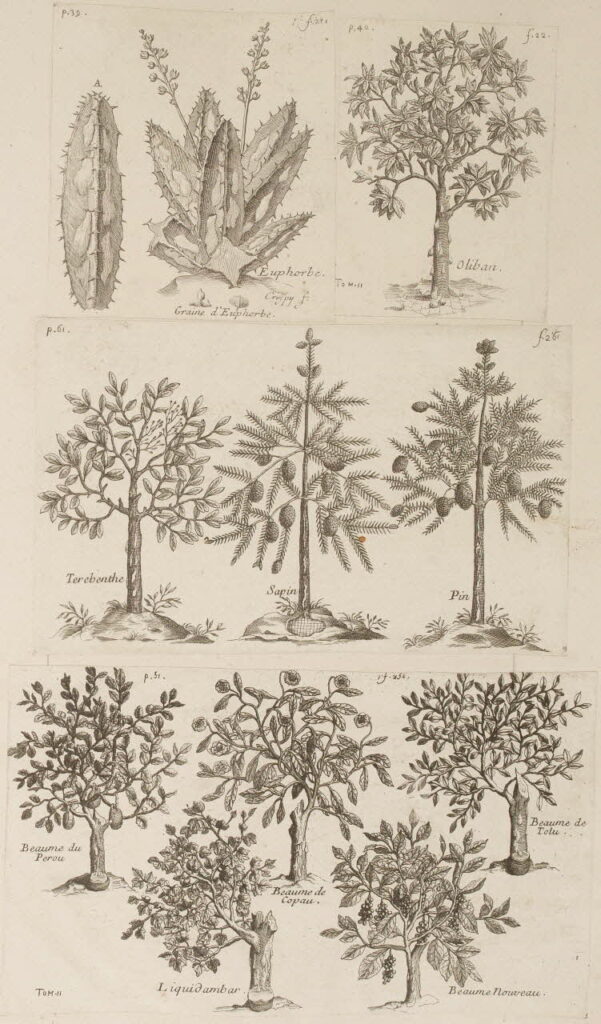
circa 1740–1756: plate 52.
(Source: Library of Rennes Métropole Les Champs libres)
The scarcity of Western representations of Boswellia sacra is also due to a long-held uncertainty over the far-off tree’s appearance. Images are not taken from nature but from earlier copies or written accounts, themselves approximative. Descriptions of the tree provided by authors of antiquity such as Herodotus, Theophrastus, Diodorus of Sicily, Ptolemy, Dioscorides and Ovid are often contradictory, when not steeped in mythology. As early as the first century CE, Pliny the Elder noted that no one could agree either on the tree’s shape or its size, and that no Greek or Latin text had been able to offer an accurate description. In 1688, in his Histoire de Louis le Grand, Jean Donneau de Visé noted: “The shape of the tree is contentious to such an extent that it has not yet been completely determined.”27Jean Donneau de Visé, Histoire de Louis le Grand contenue dans les rapports qui se trouvent entre ses actions et les qualités et vertus des Fleurs et des Plantes [History of Louis the Great encompassed by the relationship between his actions and the qualities and virtues of Flowers and Plants], Paris, 1688, fol. 18. (French ms. 6995, held at the BnF). In this peculiar book, the author gives voice to various plants in praise of Louis XIV by drawing parallels between the king’s virtues and those of the plants. The first is the myrrh tree, the second the frankincense tree, which addresses the monarch in these terms: “My shape is very much contested; King Antigonus used to say that I looked like the Terebinth, and King Juba that I was related to the Maple on the Euxin Bridge. Many are of the opinion that my leaf resembles the Bay Tree, which is the most commonly held belief. The fashion in which you are made is in no way disputed, and all people agree that if a healthy complexion and majestic and affable aspect would serve to choose Kings, and if your birth had not given you a crown, you would wear the crown for the entire world, were there but one sovereign.” However, this did not deter painter and miniaturist Jean Joubert from accompanying the text with a color picture of the tree, aligning with one of Pliny’s descriptions by giving it foliage similar to the bay tree and adding six smoking censers.
Although the handful of images produced between the late 16th century and 18th century did finally discard the symmetry and excessive oversimplification of medieval miniatures, they did not tend to come any closer to reality. André Thevet’s widely copied engraving for his Cosmographie universelle (1575) was the first to show not only the tree in a natural setting – an undulating rocky landscape – but also olibanum being harvested:28A Chinese illustration at the start of the century also depicted the resin harvest. China first discovered olibanum under the reign of Han Wudi (r. 141–87 BCE) and it took on a very important role during the Sui (581–618) and Tang (618–907) dynasties. It is described with the terms Xunlu Xiāng (薰陸香) (used as early as the third century) and Rǔ Xiāng (乳香) (from the eighth century). A 1503 copy of the 本草品彙精要 (Classified Medical Material) contains two illustrations of the frankincense tree, each with one of the two designations. The first shows resin clumps in an unusual fluorescent green color forming on the grayish trunk of a tree. The second represents a man digging around the foot of the tree (possibly in search of the tears fallen to the ground) while a few pieces of golden resin can be seen in a basket. trunk cutting and transport of the resin in jars. Nevertheless, although Thevet echoed Marco Polo29The 1930 English edition of Marco Polo’s travel stories, Travels of Marco Polo, includes a reference to “white frankincense” from the Aden region he claimed came “from a certain small tree that resembles the fir” (The Travels of Marco Polo (the Venetian), edited by Manuel Komroff, Garden City, NY: Garden City Pub. Co., 1930, p. 320). Thevet also described the frankincense-producing tree as having “the appearance of the pines that bear resin, albeit there are few men there who can boast of having seen one” (André Thevet, La Cosmographie universelle d’André Thevet cosmographe du roy [The Universal Cosmography of André Thevet, royal cosmographer], Vol. I, Paris, G. Chaudière, 1575, p. 118). in claiming similarities between the Boswellia and pine trees, the picture resembles neither one nor the other. The images derived from this engraving, such as the 1602 Histoire des drogues [History of Drugs] by Antoine Colin and Cristóbal Acosta, thus perpetuated an erroneous representation of the tree that nevertheless proved to be tenacious since it had very few competitors. Between the late 17th and 18th centuries, another representation derived from Thevet’s image was used, with only the tiniest of variations, to illustrate the Histoire générale des drogues [General history of Drugs] (1694) by Pierre Pomet, Nouvelles relations de l’Afrique occidentale [New Relations in Western Africa] (1728) by Jean-Baptiste Labat, and La Géographie sacrée et les Monuments de l’histoire sainte [Sacred Geography and the Monuments of Church History] (1784) by Joseph Romain Joly.
Botanical illustrations and taxonomic debate
(Source: Biodiversity Heritage Library)
A 1793 illustration by Benedetto Bordiga in Storia delle piante forastiere le più importanti nell’uso medico, od economico claims to represent L’Olibano. However, it only depicts a conifer-type branch consistent with the erroneous classification of Carl Linnaeus who, in 1749, asserted that the frankincense tree belonged to the Juniperus genus.30The 1761–1763 Danish expedition to Yemen should have served to rectify the mistake, since one of its goals was to accurately identify the goods mentioned in the Bible, including olibanum from southern Arabia. The expedition’s Swedish naturalist Peter Forsskål, who studied with Linnaeus, was specifically tasked with providing a botanical description of the frankincense tree, bringing back its seeds, and gathering information on the resin harvest. However, Forsskål died in 1763 before reaching the Hadramaout region where the Boswellia trees grew (Mats Thulin, The Genus Boswellia (Burseraceae). The Frankincense trees, Acta Universitatis Upsaliensis, 2020, p. 12). Consequently, the 1832 book Medical botany: containing systematic and general descriptions, written by William Woodwille and William Jackson Hooker, again claimed that olibanum was produced by Juniperus lycia and imported from Turkey and the West Indies. One of the first accurate representations of a fragment of a tree in the Boswellia genus did, however, appear in a series of pencil sketches from nature by Bolognese architect Luigi Balugani who traveled through the north of modern-day Ethiopia in 1769–1770.31“The first Europeans to see and depict a frankincense tree were James Bruce and Luigi Balugani, during their travel in Abyssinia searching for the source of the Nile. In January 1770, near the Takazze River, they found the Ethiopian frankincense tree, Anguah.” Mats Thulin, ibid. His drawings include several branches of an African species bearing flowers and fruit, but it is highly likely that these unfinished drawings did not reach much of an audience for many years.
The development of botanical science in the 19th century combined with European colonization and the expansion of international trade32For example, trade relations established between the Omani Empire and Great Britain in 1798, then with the United States of America in 1833. led to the (re)discovery of several Boswellia species. In 1807, Scottish botanist William Roxburgh, who lived in India, named the botanical genus in honor of his colleague John Boswell. As a result, the first member of the family to be described and represented was the Indian species Boswellia serrata.33Henry Thomas Colebrooke, “On Olibanum or Frankincense”, Asiatic researches, or, Transactions of the Society instituted in Bengal for inquiring into the history and antiquities, the arts, sciences and literature of Asia, Vol. 9, 1809, pp. 377–382. The species also goes under the name Boswellia thurifera, derived from the name Libanus thuriferus imagined by Colebrook (John Fleming, “On Boswellia thurifera Roxb. ex Fleming”, Asiatic Researches, or Transactions of the Society instituted in Bengal for inquiring into the history and antiquities, the arts, sciences and literature of Asia, Vol. 11, 1810, p. 158). It was several decades before the southern Arabian species34Even though Herodotus, along with other authors in antiquity, stated that Arabia was the only land to produce olibanum, and frankincense from Arabia produced by B. sacra was long known as “real olibanum” and considered to offer the highest quality, a number of 19th-century authors, particularly English ones, expressed doubts over the existence of southern Arabian frankincense. They believed its origins were more likely to lie in India, pointing to the likelihood of a colonial bias. caught up, baptized B. sacra by Swiss botanist Friedrich A. Flückiger in 1867. Three years later, Anglo-Indian botanist George C. M. Birdwood described what he felt were three new species from Somalia, including B. carterii,35George Birdwood, “On the Genus Boswellia, with Descriptions and Figures of three new Species”, Transactions of the Linnean Society of London, Vol. 27, no. 2, 1870, pp. 111–148. so similar to B. sacra that most botanists now consider them to be conspecific.36From a nomenclatural viewpoint, B. sacra and B. carterii are now treated as conspecific. However, various studies demonstrate the probability of differences between the Arabian tree and the Somalian tree (see: Xiuting Sun, Yujia Yang, Chuhan Peng, Qing Huang, Jianhe Wei, Xinquan Yang, “Frankincense from Boswellia: A review of species, traditional uses, phytochemistry, pharmacology and toxicology”, Chinese Herbal Medicines, 2025. https://doi.org/10.1016/j.chmed.2025.09.007).
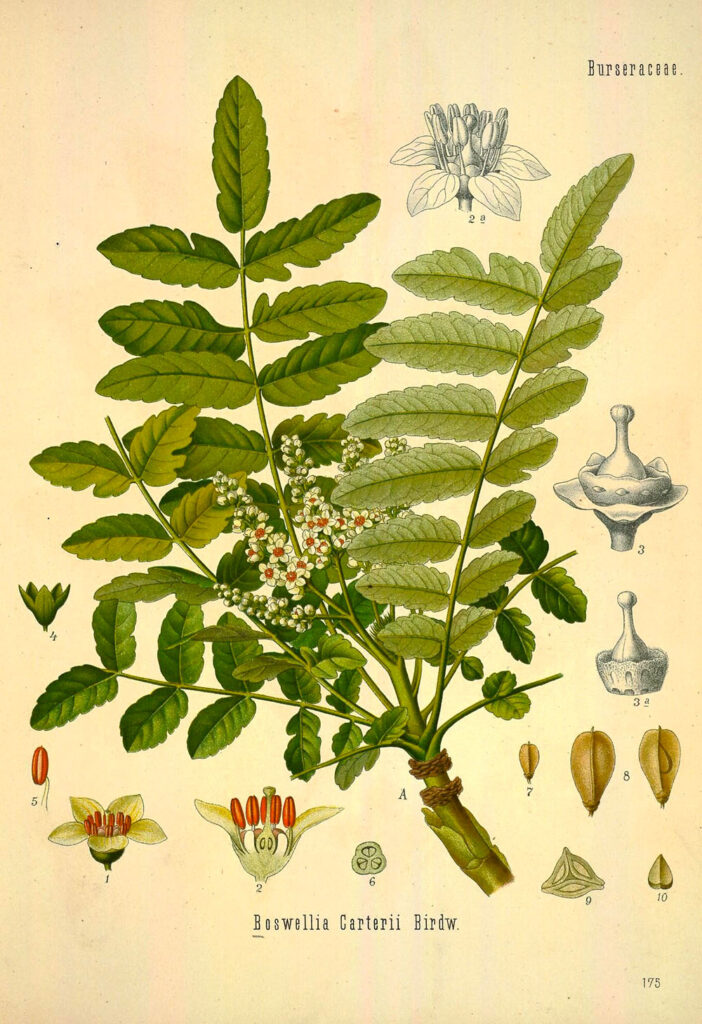
These are the two names used for the Arabian tree in late 19th-century botanical illustrations. They display a high degree of anatomical accuracy: Bark, leaflets, inflorescence, capsules and seeds are shown in detail thanks to chalcographical then chromolithographical techniques.37Chalcography is a copper-plate engraving technique which is more precise than the woodcut printing technique previously favored. Chromolithography is a method for making multi-color prints in lithography. It became the most successful of several methods of colour printing developed in the 19th century. While several deserve attention, one of the most famous is still Walter Müller’s illustration for Hermann A. Köhler’s Medizinal-Pflanzen (1887–1898). After almost 2,000 years of speculation and approximations in the West over their appearance, frankincense trees were nearing the moment of accurate representation.38In 1904, the chapter on resin-producing plants in Henri Coupin’s Les plantes originales featured a less realistic version of the tree. It was endowed with fruit strangely similar to olives and uncharacteristic lanceolate leaves, suggesting that the botanical illustrations taken from nature from the previous century had taken some time to disseminate the plant’s actual appearance. Nevertheless, until the arrival of the first photographs in the early 20th century,39One of the first photographic images of Boswellia sacra seems to have been taken in Dhofar by British diplomat and explorer Bertram Thomas in 1928. It was published in his book Arabia Felix: Across the Empty Quarter of Arabia, London, Jonathan Cape, 1932, p. 122. the tree’s general shape remained a mystery, since botanical illustrations were based on samples and only depicted branches, never the entire tree.
The tree in today’s world
Boswellia sacra’s distinctive shape is now inspiring artists and designers alike. In 2021, Anglo-Omani artist Latifah A. Stranack dedicated The Frankincense Series of ten paintings to the tree so closely intertwined with her Omani heritage. She took a dynamic approach to painting the Boswellias, imbuing each tree with a distinctive vibration and immediately recognizable shape, and placing them in an ethereal, brown- and blue-hued landscape. Some of her pieces show leaves and flowers in close-up; others depict olibanum being harvested by the quickly sketched figures of men, while still others represent women in traditional dress burning resin.
The tree inspires architects and designers as well. The Oman pavilion at Expo 2020 Dubai, designed by architecture firm F&M Middle East, was directly inspired by the shape of Boswellia sacra: The facade of light wood laths evoking branches enclosed a central space decorated with stylized plant motifs. The interior design echoed the same decorative theme, with the texture of the tree’s bark, its complex branching and its tears all suggested in various ways.
The Boswellia’s aesthetic qualities also inspired a collection of furniture by Italian designer Gaetano Pesce, invited by Amouage to visit Dofar in 2024. He drew on the undulating movement of the tree’s branches that protect it from the wind to create a series of sculpted chairs in multicolored resin. The seat back has the same stylized shape of Boswellia sacra and one of the pieces, Oman Chair with Frankincense, even uses olibanum resin for the seat structure. Pesce finally represents the frankincense tree in a way that liberates it from scientific and educational shackles, setting it free to become a purely decorative motif.
The attempt to trace the history of Boswellia sacra in images leads us deep into the history of humanity and human beliefs, of medicine and botany, of colonialism, of representation techniques and ways of seeing. The journey from the barely identifiable tree in the Punt reliefs to contemporary works is strewn with an array of images, approximative, erudite, codified, imaginary. Thanks to these images, we learn to look at Boswellia differently, through the eyes, knowledge and imagination of the artists and scientists of the past, gaining new insights into a tree that has long been shrouded in an aura of myth and mystery.








Comments